



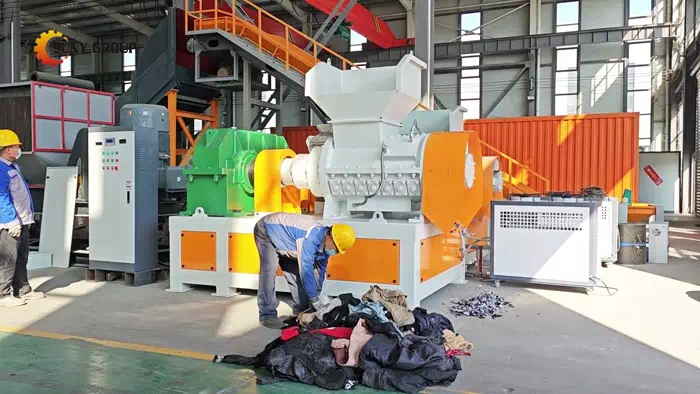
The textile spiral shredder is a piece of equipment specifically designed to reduce the volume of flexible materials, such as old clothing and fabric scraps. Utilising a low-speed, high-torque shearing mechanism, it reliably cuts bulky textile waste into manageable sizes, facilitating subsequent baling, reprocessing, or recycling. It represents a crucial pre-treatment stage for enhancing the efficiency of textile recycling.
Equipment Structure and Operating Principle
The core of the spiral shredder lies in its helical blade shaft design. Compared to traditional high-speed shredding equipment, it places greater emphasis on a combined ‘tearing and shearing’ action. Upon entering the feed inlet, the material is gradually drawn in by the helical cutter shaft. Continuous shearing force is generated through the gap between the rotating blades and the stationary blades, achieving uniform shredding. The machine is typically driven by a gear motor, operating at low speed but with high torque, enabling effective processing of highly entangled and tough textile materials whilst preventing blockages or shaft entanglement.
In terms of structural configuration, different models correspond to different processing capacities. For example, the SMC-800F model has a power rating of 7.5+1.5 kW and a processing capacity of approximately 100 kg/h, making it suitable for small-scale recycling operations; whereas the SMC-3200F utilises a 45+45+5.5 kW combined power system, with a capacity of up to 1,500 kg/h, making it suitable for centralised, large-scale processing requirements. Equipment dimensions range from 3.2 × 1.0 × 1.2 metres to 13.0 × 3.3 × 3.0 metres, allowing for flexible layout according to factory conditions.
Performance Features and Scope of Application
The advantage of this type of equipment lies not in ‘finely shredding’ but in ‘stable processing’. Firstly, the output particle size is adjustable, typically controlled between 5–150 mm or 10–300 mm, to meet the requirements of various downstream processes; secondly, low-speed operation results in lower energy consumption and reduced dust generation, better aligning with environmental production requirements.
In terms of applications, spiral shredders are not only suitable for pure cotton fabrics but can also process a wide range of materials, including blended fabrics, workwear, old bed sheets, and non-woven fabrics. They also demonstrate a certain degree of adaptability when handling old garments containing impurities such as buttons and zips; these can be fed directly without the need for complex pre-sorting, thereby improving overall processing efficiency.
Selection and Usage Recommendations
When selecting equipment, one should not focus solely on production capacity parameters; it is more crucial to ensure the machine matches the actual material type and processing objectives. If the material consists mainly of light, thin fabrics, a low-power unit will suffice; however, if heavy fabrics or compressed bales are involved, a configuration with higher torque is required. Additionally, the cutting length range is a key indicator, as different recycling applications (such as re-spinning, filling material, or fuel substitutes) have significantly varying size requirements.
During operation, ensure a consistent feed rate to avoid load fluctuations caused by overloading; regularly inspect the blades for wear to maintain cutting efficiency; and integrate the machine with conveyors or baling equipment to create a continuous production line, thereby further enhancing overall operational efficiency.