


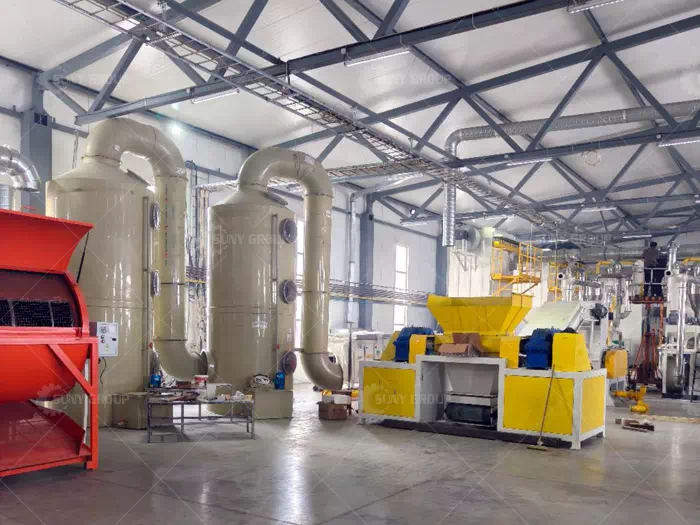

With the continuous growth of car ownership, the number of waste tires is increasing year by year. Tires are bulky and difficult to decompose; improper disposal not only occupies land resources but also poses serious environmental hazards. Addressing this industry pain point, waste tire recycling equipment utilizes mechanized and automated processing methods to transform waste tires into high-value rubber granules or powder, achieving efficient resource recycling.
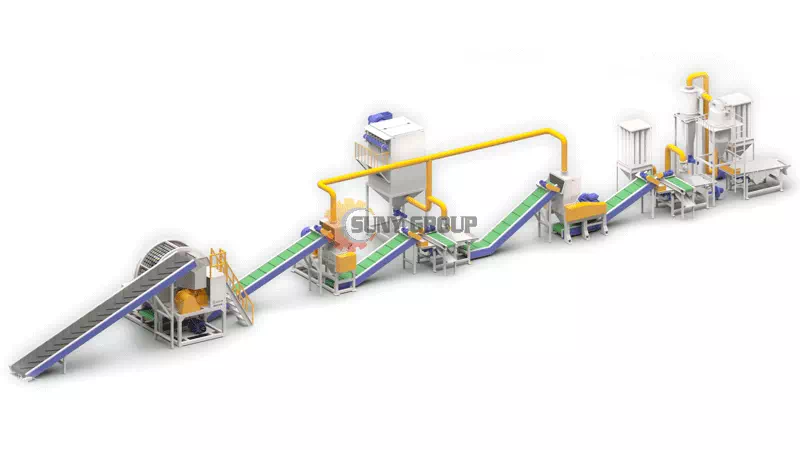
This waste tire recycling equipment is designed with the core principles of “high separation rate, high stability, and high adaptability.” The entire line integrates cutting, crushing, grinding, screening, and steel wire separation, enabling continuous and stable processing from whole tires to finished rubber products. The equipment features a reasonable structural layout and compact footprint, suitable for recycling plants and resource recovery projects of varying scales.
Waste Tire Production Recycling Equipment
During the production process, tires are first pre-processed by a cutting or shredding system, breaking down whole tires into sizes suitable for subsequent processing. Then, multi-stage crushing and grinding devices are used to fully separate the rubber from the internal steel wires. An efficient magnetic separation system accurately separates the steel wires from the rubber, ensuring high cleanliness of the rubber granules and stable metal recovery rates, laying a solid foundation for subsequent deep processing.
Depending on customer requirements for the finished rubber particle size, the equipment can be flexibly configured with coarse grinding, fine grinding, and multi-layer screening systems to produce rubber granules or ultra-fine rubber powder. The particle size range is controllable, and the finished product specifications are stable, meeting the requirements of various application fields such as rubber products, modified asphalt, and sports flooring. The entire line’s parameters are adjustable, allowing customers to adjust product structure according to market demand.
In terms of equipment design, the waste tire recycling production line utilizes wear-resistant key components and a stable transmission system, ensuring smooth operation, low failure rate, and easy maintenance. The automated control system reduces manual intervention, lowering labor intensity while improving overall production efficiency and operational safety.
Furthermore, the equipment fully considers environmental protection and energy saving requirements, with good dust and noise control and reasonable energy consumption levels, meeting the standards of green production in the modern resource recovery industry. Through the efficient processing of waste tires, it not only recovers rubber and steel wire resources but also significantly reduces the environmental burden, creating sustainable economic value for enterprises.
This waste tire recycling production equipment provides a mature and reliable solution for the tire recycling and rubber regeneration industry. For information on equipment configuration, production capacity options, or project details, please contact us to get the most suitable tire recycling solution for your needs.
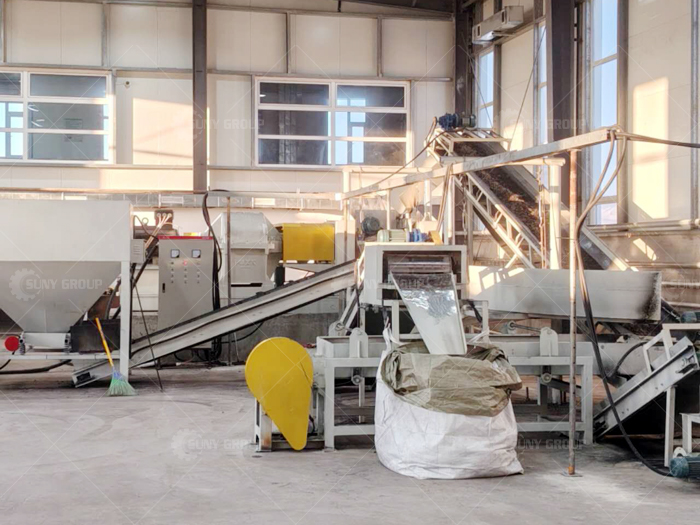
Tire Recycling Equipment at the Site in Mongolia
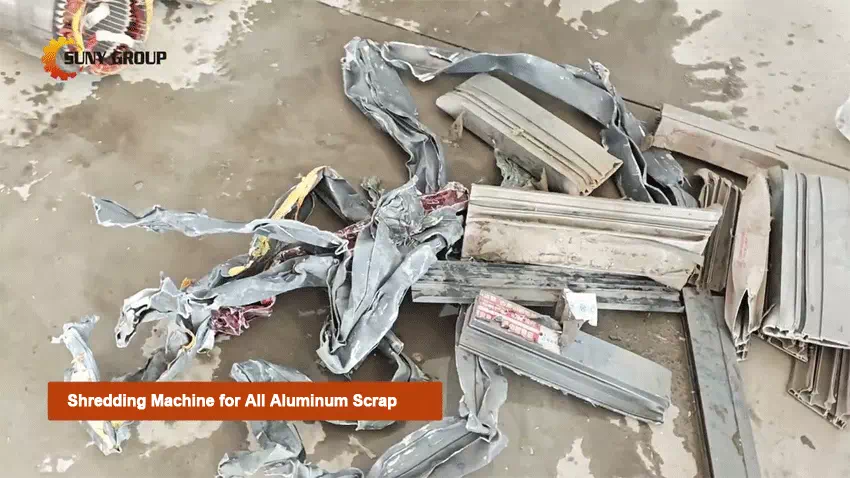
Whether it’s used beverage cans, aluminum profiles, or scrap aluminum sheets and foils, all aluminum scrap needs effective size reduction before subsequent sorting and smelting. The aluminum scrap shredder is the core starting equipment in the recycling production line. Its function is to break down large, irregularly shaped aluminum products into uniformly sized materials, creating stable conditions for subsequent sorting, impurity removal, and smelting.
Working Principle and Configuration of Aluminum Shredders
Professional aluminum scrap shredders typically employ a heavy-duty structural design, combined with high-strength rotors and wear-resistant blades, to shear, tear, and crush aluminum products at a stable rotational speed. Taking the recycling of used beverage cans as an example, the entire shredding system can consist of a single-shaft shredder and a granulator. The material is first coarsely shredded, and then further refined to achieve a more uniform final output size. If a finer particle size is required, a hammer mill unit can be added to reduce the output size further, meeting the needs of various recycling processes. The machine is designed for continuous operation and can withstand high-load conditions for extended periods, making it suitable for large-scale aluminum recycling projects.
Equipment Advantages and Application Value
High-performance aluminum scrap shredders offer significant advantages in efficiency, safety, and economy. First, their high-throughput design allows for rapid processing of large quantities of aluminum scrap, significantly improving the overall efficiency of the recycling line. Second, the equipment is equipped with a comprehensive safety protection system, including safety locks, emergency stop, and anomaly monitoring functions, effectively reducing risks during operation and maintenance. Third, the machine has a robust structure and long-lasting wear parts, which help reduce long-term operating and maintenance costs.
With its excellent adaptability to various types of aluminum scrap, this type of shredding equipment is widely used in used beverage can recycling, industrial aluminum scrap processing, and comprehensive metal recycling projects. Through stable and efficient front-end shredding, it not only improves the overall efficiency of aluminum recycling but also creates higher economic value for subsequent sorting and smelting processes.
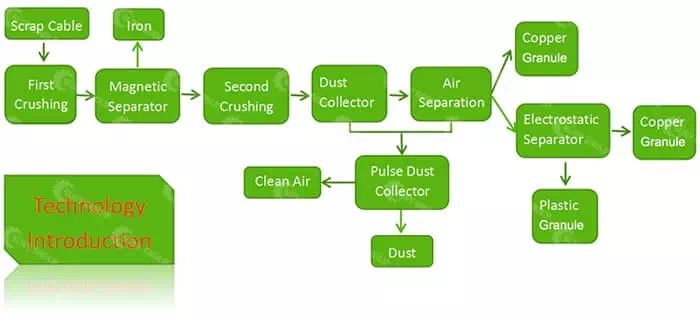
In the field of waste wire and cable recycling, not all enterprises require large-scale production lines. For recycling stations, small processing plants, or new investors entering the industry, compact copper cable granulator machines—characterized by their small footprint, low investment, and high recovery rate—often hold greater practical value. These devices are designed specifically for small-to-medium-scale copper wire recycling, with core advantages in compact structure and simple operation.
Core Equipment Structure and Workflow
Copper Wire Granulator Principle
Small copper cable granulator machines typically consist of a crushing system, an air separation system, and a screening system. Upon entering the equipment, waste cables are first cut and crushed by a high-intensity crushing unit, thoroughly separating the copper core from the outer plastic layer. The crushed mixture then enters the air separation zone, where lighter plastic particles are preliminarily separated from heavier copper granules through airflow differences.
Subsequently, the material undergoes secondary classification via a vibrating screen or fine screening device, concentrating copper particles for higher purity. The entire process operates continuously, achieving stable recycling without frequent manual intervention.
Equipment Advantages and Applications
Compared to large-scale production lines, small copper cable pelletizers offer greater efficiency in energy consumption, maintenance, and space requirements. Typically featuring modular design, they enable swift installation and commissioning, making them suitable for facilities with limited floor space. With proper configuration, a single unit can process diverse waste wire types, including household wiring, communication cables, and certain automotive harnesses.
Crucially, these compact systems maintain high copper-plastic separation efficiency while significantly lowering initial investment thresholds. For recyclers seeking rapid ROI and flexible operations, such copper cable granulators offer a practical solution that balances efficiency and cost-effectiveness.
Designed around the principles of “adequate, user-friendly, and durable,” our compact copper cable granulator enables high-value recycling of scrap wires even at limited scales. It provides stable and reliable technical support for small to medium-sized recycling projects. For further details, feel free to contact us anytime.
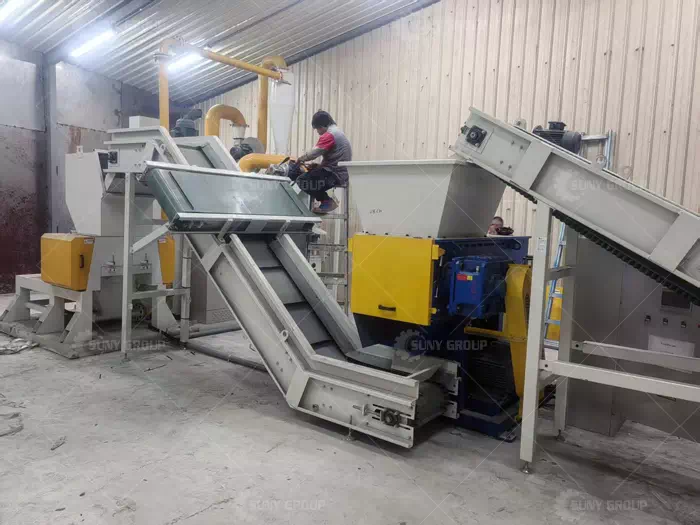
Taiwan Cable Wire Recycling Machine On-site
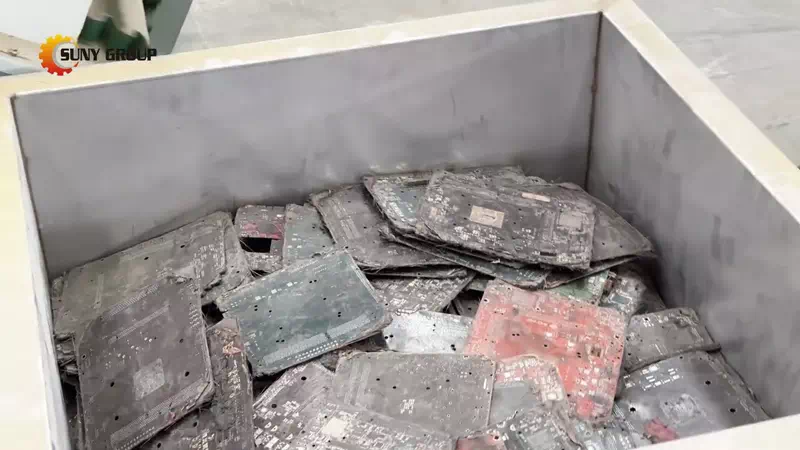
Waste circuit boards contain both recyclable metals, such as copper, and non-metallic materials, such as fiberglass and resin, resulting in a complex structure and interwoven components. If the process route is not designed properly, it will not only result in low recovery rates but also cause equipment wear and energy waste. The core value of a circuit board shredding and sorting production line lies in achieving efficient separation of metals and non-metals through a scientific process and specialized equipment.
Process Flow
The entire production line usually starts with pre-treatment. Clean waste circuit boards first enter a double-shaft shredder for primary crushing, cutting the entire board into uniformly sized pieces. The goal of this stage is not to crush the material to a very fine size, but to create stable and controllable feeding conditions for subsequent fine crushing.
The material after primary crushing enters a secondary fine crushing equipment, where the size is further reduced through shearing and impact. Subsequently, the material is processed into a particle size suitable for sorting using a pulverizer, allowing for the physical separation of metals and non-metals as much as possible, providing a foundation for downstream sorting.
Technical Principles
After crushing, the material enters the sorting system. First, using the difference in specific gravity, a gravity separation device is used to initially separate the denser metal particles (such as copper) from the lighter non-metallic materials (fiberglass, resin powder).
However, in actual operation, some metals are pulverized during the grinding process and mixed with non-metallic powders, making it difficult to completely separate them with single-stage gravity separation. At this point, electrostatic separation equipment plays a crucial role. Through the difference in conductivity of different materials, electrostatic separation can further accurately separate metal powder from non-metallic powder, significantly improving the overall recovery rate and product purity.
After multi-stage sorting, the metal and non-metallic materials are collected separately and can be directly used in subsequent deep processing or sales.
Compared to simple and crude direct crushing methods, this multi-stage crushing and combined sorting system for circuit boards is more suitable for long-term stable operation. The entire line has a high degree of automation, requires minimal manual intervention, and has controllable operating parameters, effectively reducing operating costs.
At the same time, the system has significant advantages in terms of recovery rate, environmental compliance, and equipment durability, meeting both resource recycling needs and current environmental requirements for electronic waste treatment. For companies looking to enter the e-waste recycling business, this mature and well-defined process solution is easier to implement and offers greater potential for sustained profitability.