



Against the backdrop of the rapid development of the new energy industry, the recycling and processing of end-of-life lithium-ion batteries is no longer merely an environmental issue, but also a vital gateway to resource reuse. Compared to simple dismantling or crude processing, a comprehensive lithium-ion battery recycling system is the true key to determining recycling efficiency and economic value.
A Core Equipment System Integrating Multiple Processes
A lithium-ion battery recycling production line comprises a range of coordinated equipment, covering key stages such as discharge, pre-treatment, crushing, and safety control. Firstly, end-of-life batteries enter specialised discharge equipment, where they are fully discharged in a sealed environment to eliminate safety hazards posed by residual charge. Subsequently, the material enters the pre-treatment system, where dual-shaft shredders or primary crushers dismantle the batteries, breaking down their structure.
The focus of this stage lies in ‘safe and stable feeding’ rather than the degree of fine crushing. The equipment is typically fitted with dust extraction and sealing systems to effectively control the release of dust and harmful gases, providing a stable operational foundation for subsequent processes.
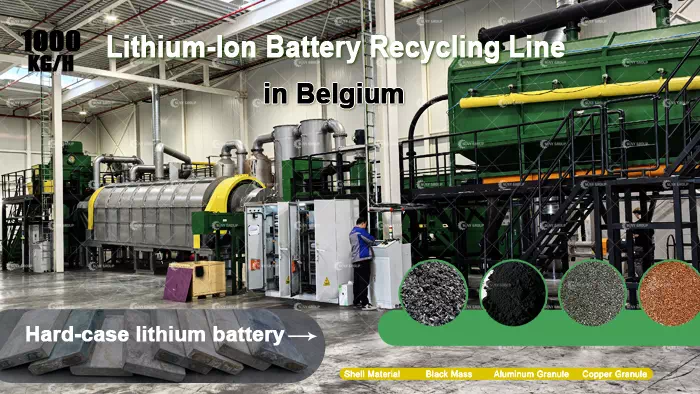
Machines for the Recycling of Lithium-ion Batteries
Low-Temperature Treatment and High-Efficiency Crushing and Separation
Following pre-treatment, the material enters a low-temperature volatilisation or drying system, where heating and temperature control are used to remove electrolyte and moisture. This process not only enhances the efficiency of subsequent separation but also reduces the risk of equipment corrosion.
This is followed by the core crushing stage, where a hammer mill further pulverises the battery materials through high-speed impact, ensuring thorough dissociation of the copper foil, aluminium foil, and electrode coatings. In conjunction with trommel screens and air classification systems, materials of different particle sizes and densities are sorted, achieving preliminary separation. The key to this stage lies in thorough dissociation; otherwise, it will directly affect the purity of the black powder.
Multi-stage Sorting and High-Purity Recovery
Following fine processing, the system proceeds to the multi-stage sorting phase. Ferrous materials are separated using magnetic separation equipment, whilst air classification and density separation are employed to progressively extract copper, aluminium, and separator materials. The resulting black powder is rich in key metallic elements such as lithium, nickel, cobalt, and manganese, serving as a vital feedstock for subsequent hydrometallurgical extraction.
The design of the entire equipment emphasises high recovery rates and strict impurity control. Copper and aluminium recovery rates can reach over 98%, whilst black powder recovery rates are consistently maintained at a high level. Concurrently, this effectively reduces metal carryover issues and enhances overall resource utilisation efficiency.
At its core, lithium-ion battery recycling is a competition of ‘equipment capability’. Only production lines equipped with a complete process and efficient sorting capabilities can consistently generate stable value during actual operation. professional e-waste PCB recycling and precious metal recovery facility