



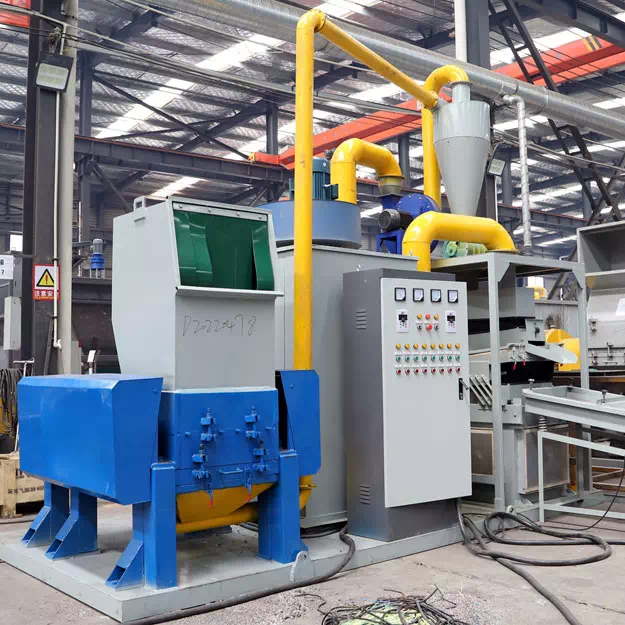
The interior of cables typically consists of copper conductors and plastic insulation. Direct processing is not only inefficient but also leads to resource wastage. Consequently, specialised cable shredding and separation equipment has progressively become an essential tool within the wire recycling industry. Through a comprehensive suite of industrial shredding and sorting machinery, waste cables can be rapidly processed, enabling the efficient separation of copper from plastic.
Single-shaft shredders perform primary shredding.
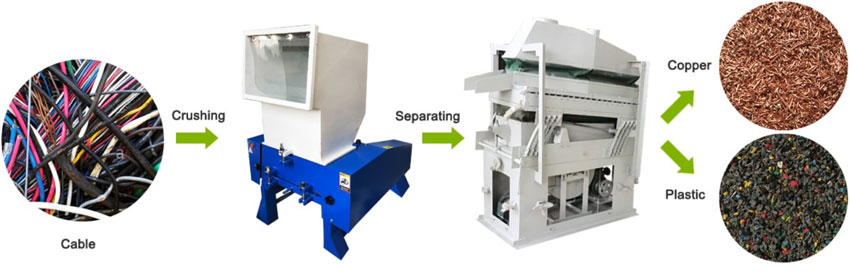
In cable recycling operations, the initial step typically involves using single-shaft shredders for preliminary shredding of waste wires and cables. Featuring high-strength shafts and wear-resistant blades, this equipment effortlessly processes cables and wires of various specifications, including mixed cables, thick cables, and insulated wires.
Industrial Shredders and Cable Separators
Operating at low speed with high torque, the single-shaft shredder reduces large cable volumes into smaller, block-like structures, preparing them for subsequent crushing. This equipment offers stable operation, along with automatic control and overload protection features, making it widely adopted in industrial recycling production lines.
Further processing with crushing and granulating equipment
The preliminarily shredded cable material is conveyed to a crusher for secondary pulverisation. The crusher further processes the cable fragments into smaller particles, gradually separating the copper wires from the plastic sheathing. Subsequently, these materials enter a granulator for refinement, transforming the mixture into uniform pellets.
Once the pellets reach the appropriate size, the equipment employs an air classification system for separation. Leveraging the weight and density differences between copper and plastic pellets, the air separator efficiently segregates the two materials, yielding preliminary copper pellets and plastic pellets.
Electrostatic Separation Enhances Copper Purity
Should higher-purity copper be required, electrostatic separation equipment can be incorporated at the production line’s end. Electrostatic separators exploit differences in material conductivity, using an electric field to further segregate copper and plastic particles, thereby enhancing the purity of the copper granules.
Through this comprehensive processing sequence, copper resources from waste cables can be efficiently recovered, while the plastic can be reused as recycled material. This approach not only improves resource utilisation but also reduces environmental pollution.