



PRODUCT DESCRIPTION
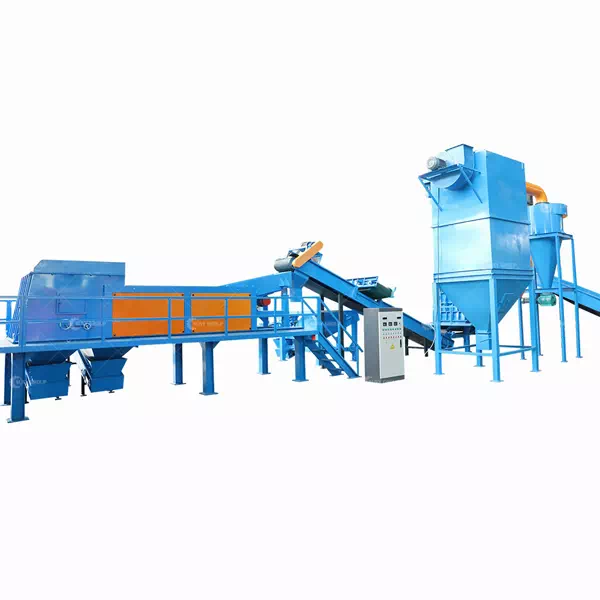
With the surge of waste, recovering non-ferrous metals efficiently is critical. Traditional methods fail to separate non-magnetic metals. To solve this, our Eddy Current Separator was developed. It automatically recycles high-value copper and aluminum from industrial and municipal solid waste, boosting recycling efficiency and sustainability.
APPLICATIONS & MATERIALS
This equipment is widely utilized for the fine screening, enrichment, and recovery of various mixed metallic and non-metallic materials:
E-waste Recycling: Recovery of metals from printed circuit boards (PCBs) dismantled from waste household appliances, PCB leftover materials, and circuit board drilling powder waste.
Scrap Wire & Cable Shredding: Separation of miscellaneous wires, waste home appliance dismantling wires, copper-plastic wires, aluminum-plastic wires, fine flexible cables, computer connection wires, automobile/motorcycle battery cables, and automotive wiring harnesses.
Radiator Separation: High-efficiency separation of aluminum and copper from automotive copper-aluminum radiators and air conditioner radiators.
ELV & Appliance Shredded Scrap: Non-ferrous metals recovery from crushed waste appliances such as automobiles and refrigerators, as well as aluminum separation from automobile sealing strips.
Plastic & Waste Sorting: Separation of aluminum-containing substances from PET bottle flakes, aluminum foil separation from PC plastics, aluminum-plastic composite materials, and aluminum extraction from aluminum-plastic doors and windows.
STRUCTURE & WORKING PRINCIPLE
Main Components
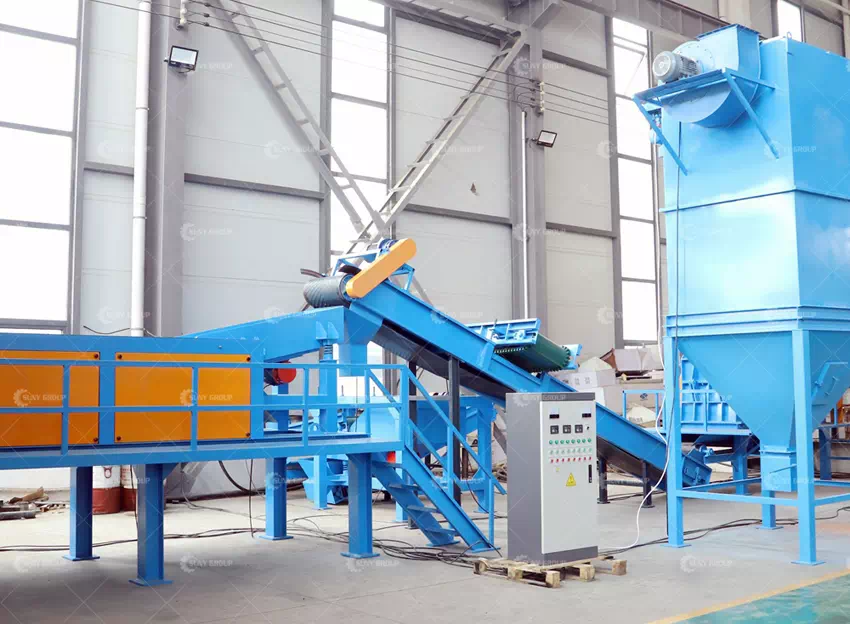
The main body of the equipment features a compact design and highly stable operation, primarily consisting of the following components:
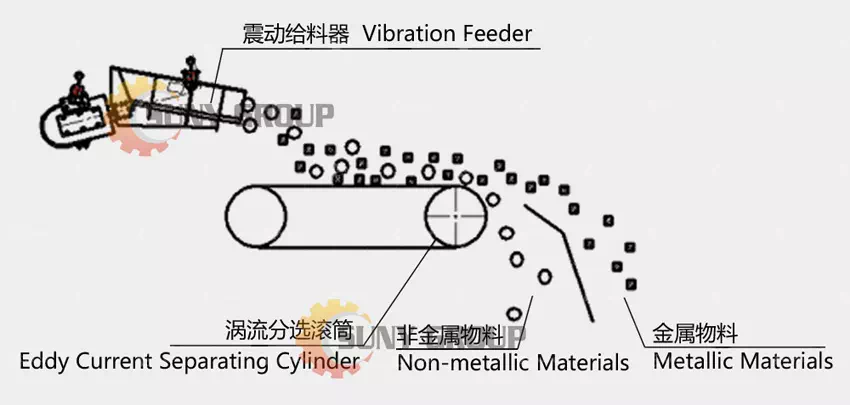
Vibrating Feeder: Ensures that mixed materials are evenly and consistently distributed onto the sorting conveyor belt.
Material Conveying System: Includes a durable material conveyor belt, a belt drive drum, and a speed-adjustable reduction motor.
Eddy Current Separating Cylinder: The core separation component, equipped with a high-gradient permanent magnet assembly rotating at high speeds.
Control Cabinet & Protective Cover: Features an integrated intelligent control cabinet and an industrial-grade safety protective cover.
Working Principle
High-Frequency Alternating Magnetic Field: While working, the magnetic roller rotating at high speed produces a high-frequency alternating intense magnetic field on its surface.
Induced Eddy Current: When conductive non-ferrous metals (such as aluminum and copper) pass through this magnetic field, an eddy current is induced inside them.
Opposite Magnetic Repulsion: The induced eddy current itself generates a magnetic field that is opposite to the original magnetic field’s direction.
Precise Leaping Separation: Due to the strong repulsion of the magnetic fields, the non-ferrous metals leap forward along the conveying direction, while non-metallic materials (such as plastics or glass) drop naturally due to gravity, achieving perfect separation.
PRODUCT FEATURES & ADVANTAGES
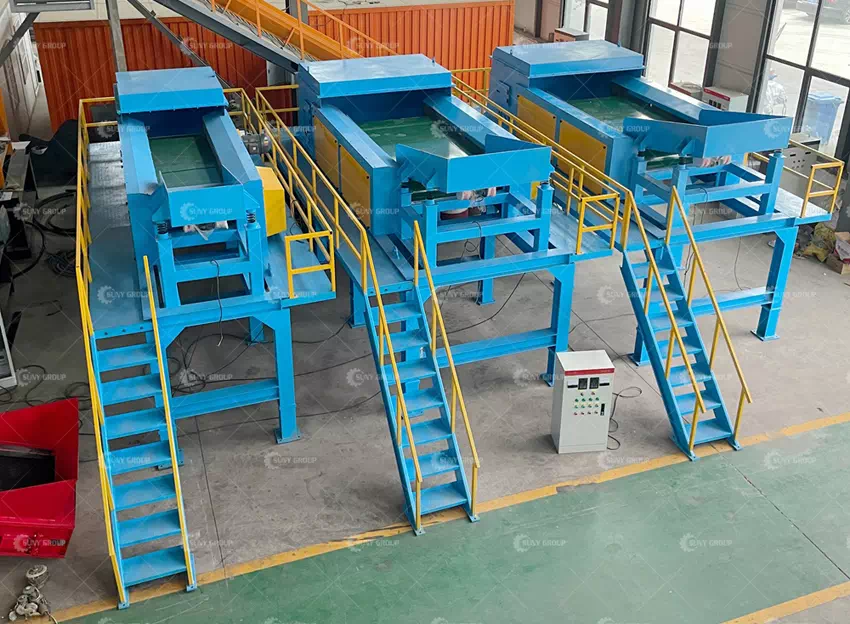
Wide Particle Size Range: Highly flexible in sorting, capable of separating a wide range of metal particle sizes, typically ranging from 3 mm to 100 mm.
Energy Efficient & Easy Maintenance: Equipped with a high-gradient rare earth permanent magnet system, ensuring exceptionally low energy consumption while maintaining high magnetic intensity, alongside easy routine maintenance.
Precise and Accurate Sorting: Supports different rotor directions, allowing accurate sorting of materials with various particle sizes by fine-tuning the operation parameters.
Customization & Flexible Integration: Can be customized based on specific material types and customer requirements, seamlessly integrating with new or existing crushing and recycling production lines.
Multiple Models Available: Available in various models ranging from ZY400 to ZY1500 , with tray/belt widths from 300 mm to 1500 mm. The processing capacity spans from 2 t/h to 15 t/h, perfectly meeting diverse production scale requirements.
FAQ
Q1: Are there any preprocessing requirements for materials before entering the eddy current separator?
A: Yes. Before eddy current separation, the materials need to be relatively uniform in size, which is usually achieved by pre-crushing. Our company can provide complete crushing and separation solutions tailored to specific materials and customer requirements.
Q2: How do I determine if my mixed materials are easy to separate using this machine?
A: The main criterion to distinguish is the ratio of material conductivity and density values. Materials with a higher ratio value (such as aluminum and copper) generate a stronger repulsive force in the alternating magnetic field and are much more likely to be separated with high purity.