



In the recycling of end-of-life motors, the efficient separation of copper and iron directly determines both the recovery value and processing efficiency. To this end, the motor stator disassembly equipment developed by Suny Group enables the precise processing of motors of various sizes, thereby increasing copper recovery rates and reducing labour costs.
Equipment Configuration and Division of Labour
A complete motor stator disassembly solution typically comprises two core types of equipment: the motor stator cutting machine and the three-function motor stator recovery machine. These are not substitutes for one another, but rather complementary pieces of equipment designed to work in tandem through sequential processes. The cutting machine is primarily designed for large-volume, densely structured scrap motor stators. It uses mechanical cutting to open the stator casing, creating the conditions for subsequent copper wire separation; whilst the three-function machine undertakes more precise processing tasks, suitable for cutting, ejecting, and extracting copper wire from small and medium-sized motor stators, thereby achieving a more complete separation of copper and iron.
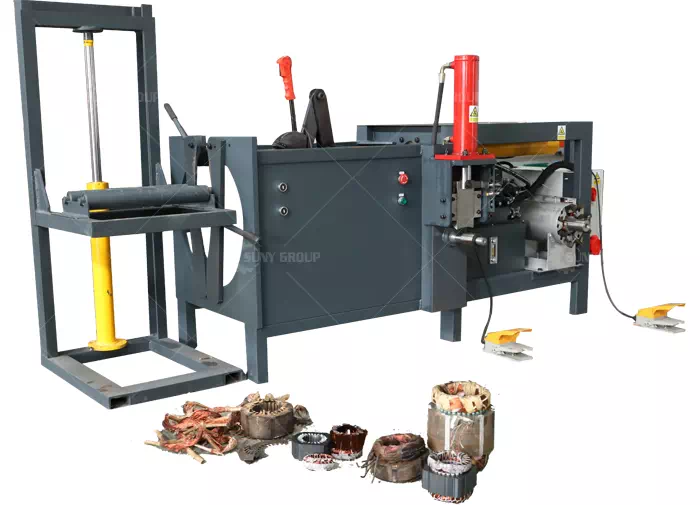
Copper Motor Disassembly Machine
Analysis of Core Equipment Functions
The core value of the motor stator cutting machine lies in ‘breaking down the structure’. With large motors, the internal windings are tightly packed and highly rigid, making traditional manual disassembly difficult and inefficient. By using high-strength cutting tools, the outer ring of the stator can be rapidly cut open, exposing the internal copper windings and significantly reducing the difficulty of subsequent processing.
The three-function motor stator recycling machine, on the other hand, focuses more on “precision processing”. Integrating cutting, ejection, and copper extraction into a single unit, it is capable of extracting the copper wires from within the stator—either as a whole or in bundles—after the initial cutting is complete, thereby reducing copper loss and improving the purity of the recovered material. This type of equipment is particularly suitable for small and medium-sized motors; it offers flexible operation and strong adaptability, making it a crucial component in achieving automated dismantling.
Synergistic Operation Enhances Overall Efficiency
In actual production, these two types of equipment typically operate in tandem. Large motors are first processed by the cutting machine before entering the three-function unit for copper wire separation; small and medium-sized motors, however, can proceed directly to the three-function unit for end-to-end processing. This tiered processing approach not only improves equipment utilisation but also ensures that materials of different specifications receive tailored processing solutions, thereby guaranteeing overall recycling efficiency and cost-effectiveness.