



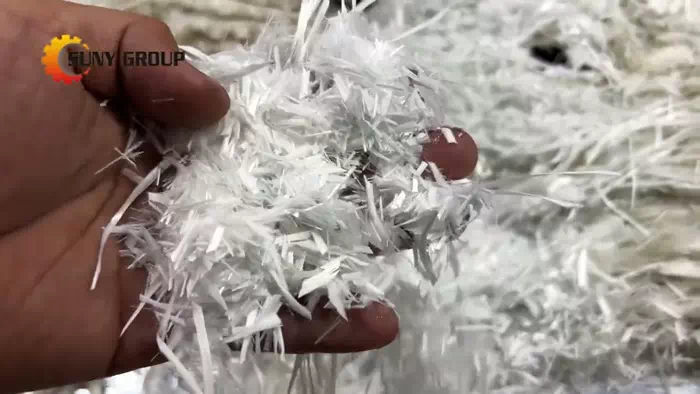
A fiber cutting machine is specialized equipment designed for processing various types of waste fiber materials. It is capable of cutting materials—such as glass fibers, carbon fibers, aramid fibers, and yarn scraps—into precise, controllable lengths, thereby facilitating resource recycling and enhancing the efficiency of downstream processing. This equipment is widely utilized across the composite materials, construction materials, and textile industries.
Equipment Functionality and Scope of Application
This equipment features an optimized design specifically engineered to address the challenges associated with the complex variety and tangled nature of waste fibers. It is capable of processing a wide range of materials, including glass fibers, carbon fibers, aramid fibers, mineral fibers, and organic fibers. Utilizing a robust feeding and cutting system, the machine can continuously process fibers in loose, knotted, or mixed states, thereby minimizing the need for manual sorting and preliminary preparation steps.
Its core value lies in its “high compatibility”: a single machine can accommodate multiple types of fibers, making it an ideal solution for recycling enterprises or manufacturing environments that require the processing of diverse materials.
Adjustable Cutting and Structural Features
The equipment incorporates an adjustable cutting mechanism that allows users to set the fiber length according to specific application requirements, enabling flexible switching between short-staple and medium-to-long staple fibers. This precise length control capability directly influences the performance of downstream products—for instance, by enhancing the reinforcing effect in composite materials or ensuring uniformity in filler materials.
In terms of structural design, the machine is typically outfitted with wear-resistant cutting blades and a stable transmission system. This configuration allows it to effectively handle the cutting demands of high-strength materials—such as carbon fibers and aramid fibers—while simultaneously accommodating the flexible processing requirements of organic fibers. This ensures a stable and continuous cutting process, effectively minimizing issues such as material clogging and tangling.
Application Value and Resource Recycling
Fibers that have undergone this precise cutting process can be repurposed for various applications, including the reinforcement of composite materials, the production of thermal insulation materials, or the manufacturing of recycled textile products. This “waste-to-reuse” transformation pathway significantly boosts material utilization rates and helps enterprises reduce their raw material costs.
For the recycling industry, this equipment not only streamlines processing workflows but also enhances the consistency of the finished output, thereby elevating the intrinsic reuse value of waste fibers. Its applications span across numerous sectors, including construction, automotive, aerospace, and textiles. For further details, please contact us.