


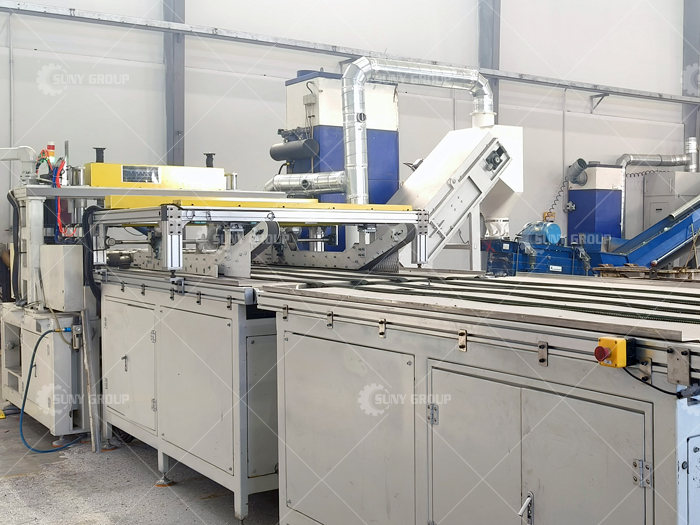
Czech Photovoltaic Panel Recycling Plant Customer Site

Czech Photovoltaic Panel Recycling Plant Customer Site
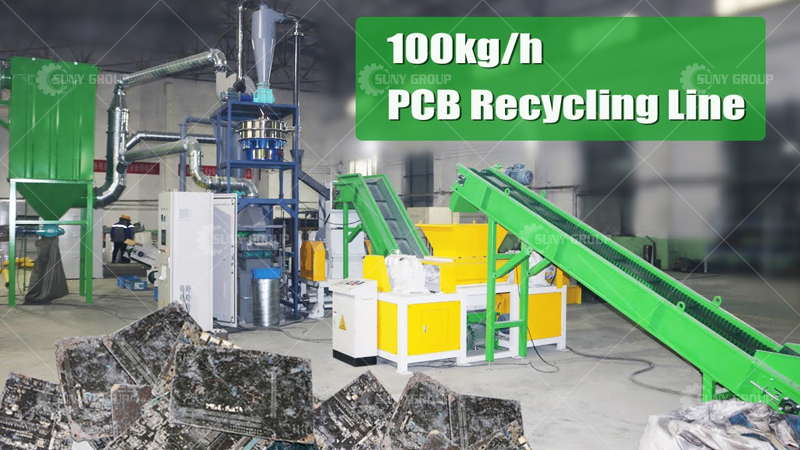
The core of the e-waste shredding production line lies in “fine disassembly + efficient sorting.” The entire system typically consists of a loading and conveying system, a shredder, magnetic separation equipment, an eddy current separator, an airflow separator, and a dust removal device.
First, the e-waste is conveyed by conveyor to a heavy-duty shredder for initial shredding. The material then enters a secondary crushing stage, where it is further refined to a particle size suitable for sorting and separation. Metals and non-metals are then effectively separated through magnetic and eddy current separation processes, ultimately achieving high-purity recovery of materials such as copper, aluminum, iron, and plastic.
This production line processes a wide range of materials, including used computer motherboards, mobile phones, televisions, and rice cookers, as well as scrap circuit boards, cables, and hard drives from industrial equipment. Flexible configuration modules can be adjusted to meet different types of e-waste, providing customized processing solutions.
Environmentally, the system is equipped with multi-stage dust removal equipment to effectively control dust and odor throughout the entire processing process, complying with national environmental standards. Regarding resource recovery, the high separation rate ensures maximum metal recovery, significantly increasing economic value.
In general, the electronic waste crushing and recycling production line is not only a manifestation of sustainable development but also a modern solution that combines economic benefits and social value. It is suitable for scenarios such as environmental protection enterprises, recycling stations, and large industrial parks that have large-scale demands for electronic waste treatment.
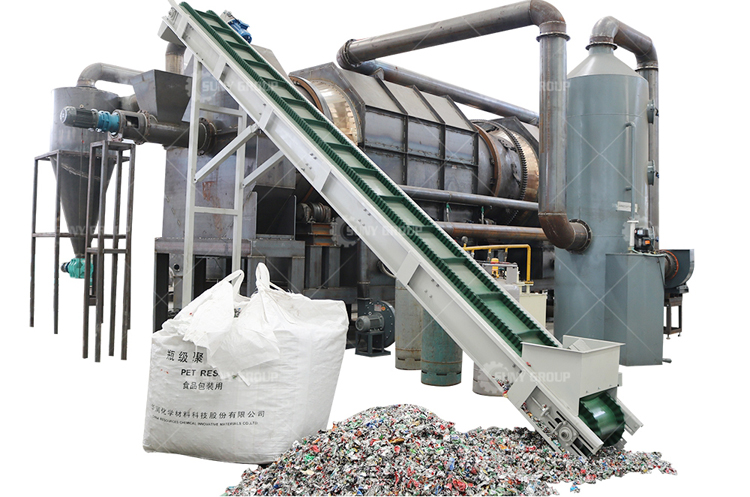
Paint stripping is a crucial step in the recycling and reuse of UBC’s scrap aluminum cans. This technology not only effectively reduces metal loss but also minimizes environmental emissions, making it a crucial component of sustainable development.
Our paint stripping technology utilizes a rotary kiln to heat UBC’s scrap aluminum can fragments. During this process, convective heat transfer effectively removes the organic coating on the can surface. This unique thermal treatment ensures superior paint stripping results, ultimately resulting in high-quality paint-free aluminum.
Decoting Machine for UBC Scrap Can
Our technology offers significant advantages over traditional recycling methods. First, it significantly improves the purity of the recycled aluminum, thereby increasing its value in downstream applications. Second, because the organic coating is removed in a controlled environment, hazardous emissions are significantly reduced, complying with increasingly stringent environmental regulations. Furthermore, the optimized process reduces energy consumption, further improving recycling efficiency and profitability.
We understand that efficient and environmentally friendly recycling technology is key to a circular economy in the aluminum industry. Our paint stripping solution is designed for this purpose. It’s more than just a piece of equipment; it’s a proven process designed to help you stand out in a competitive market.
If you are interested in recycling and repurposing aluminum cans at UBC and would like to learn how we can enhance your business value through advanced paint stripping technology, we sincerely invite you to contact us. Our professional team will provide you with personalized guidance and customized solutions.
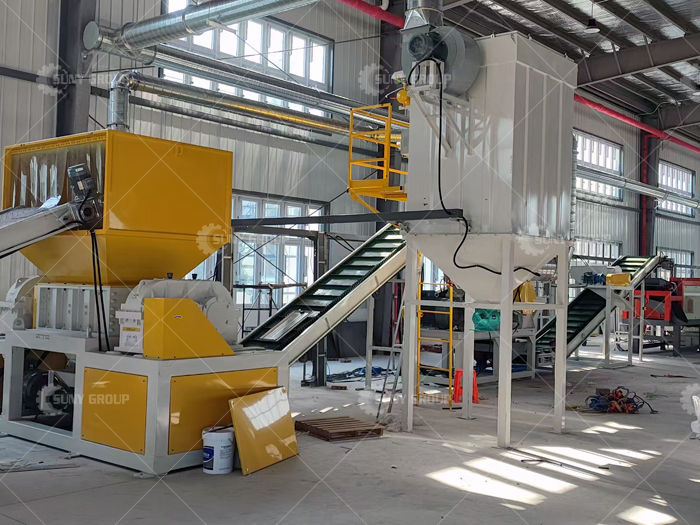
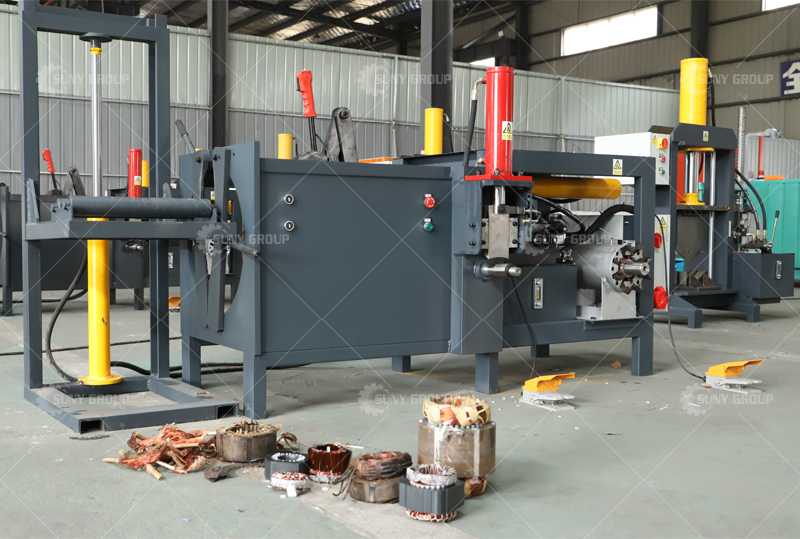
The stator copper extractor is a highly efficient equipment specially used in the motor recycling industry. It is mainly used to quickly separate the copper wire in the waste motor from the stator core. With the widespread use of motors in the industrial, home appliance and automotive fields, the demand for recycling waste motors has increased year by year, and how to extract copper wire efficiently and with low loss has become the key. The stator copper extractor is designed for this purpose. It can greatly improve the copper recovery rate, while reducing the tedious process of manual disassembly and improving overall work efficiency.

Stator Copper Extractor Machine
The equipment usually adopts a hydraulic or electric drive system to push out the copper wire inside the stator as a whole or pull it out in sections through a strong thrust to avoid the damage of the copper wire caused by traditional cutting methods. With the automatic clamping and rotating device, stators of different sizes can be accurately fixed and quickly processed. The whole operation process is simple. The staff only needs to put the stator into the equipment and start the program to complete the separation of the copper wire and the core, which greatly saves manpower and time costs.
In terms of performance, the stator copper extractor has the characteristics of high efficiency, low noise, safety and stability. Some models are equipped with an automatic adjustment function, which can automatically adjust the working stroke according to different specifications of stators, so as to achieve multiple uses of one machine. Its sturdy body structure and wear-resistant tool design ensure long-term stability and low maintenance costs. At the same time, the equipment pays attention to environmental protection in its design, and the separated iron core can be directly recycled and reused to maximize resource utilization.
For waste motor recycling companies, the use of stator copper extractors can not only improve the purity and recovery rate of copper, but also shorten the disassembly cycle and increase overall production capacity. With the continuous increase in the value of copper resources, the return on investment of such equipment is also getting higher and higher. Whether it is a small or medium-sized recycling station or a large recycling company, the stator copper extractor is an ideal choice for improving recycling efficiency and reducing operating costs, providing an efficient, economical and environmentally friendly solution for the motor disassembly industry.
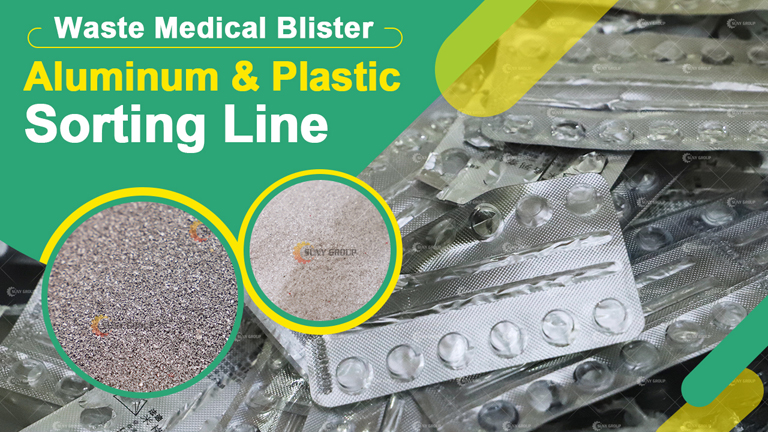
Pharmaceutical aluminum-plastic blister packaging (medicine board) is widely used in the packaging of solid medicines such as capsules and tablets. Because the aluminum foil and plastic are tightly compounded, they have good sealing properties, but they also make recycling difficult. Traditional manual separation is inefficient and polluting, and it is difficult to meet environmental protection needs. The Pharma Blister Packing Recycling Machine is designed to solve this problem and provide efficient and environmentally friendly separation and recycling solutions.
Pharma Blister Packing Recycling Machine
Through multiple process flows such as mechanical crushing, high-temperature separation, and electrostatic sorting, the equipment can efficiently peel off the aluminum and plastic layers to achieve complete separation and recycling of the two materials. The entire system runs fully automatically without manual participation, greatly improving the processing efficiency. It is suitable for pharmaceutical factories, medical waste treatment centers, and renewable resource enterprises. Especially when processing waste medicine boards, the recovery rate is as high as more than 99%, and the separated aluminum foil and plastic particles can be directly used for reprocessing or sales, truly achieving a win-win situation of resource regeneration and economic benefits.
In addition, the recycling machine has a compact structure, small footprint, easy operation, and is equipped with an intelligent control system that can automatically adjust parameters according to different materials to ensure a safe and stable processing process. The equipment is equipped with a dust removal system and a noise control device during operation, which meets environmental protection standards, effectively avoids secondary pollution, and truly achieves green recycling.
With the continuous expansion of the production capacity of the pharmaceutical industry, the pressure on the treatment of pharmaceutical packaging waste is also increasing. As a professional equipment designed specifically for pharmaceutical blister waste, the Pharma Blister Packing Recycling Machine not only solves the problems of low efficiency and heavy pollution in traditional methods, but also promotes the automation and environmental protection of pharmaceutical packaging waste treatment. Choosing this equipment means that the company is one step further on the road to green production and resource recycling.
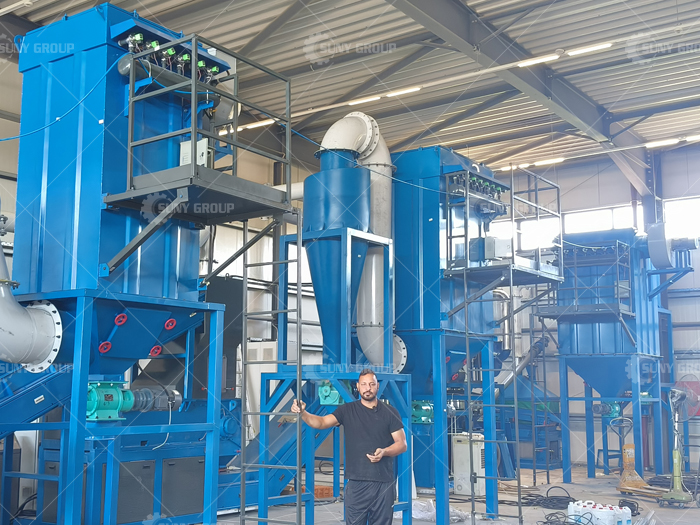
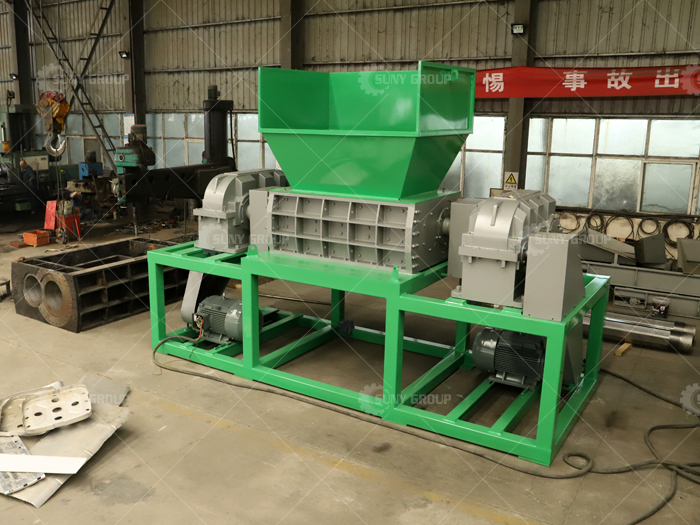
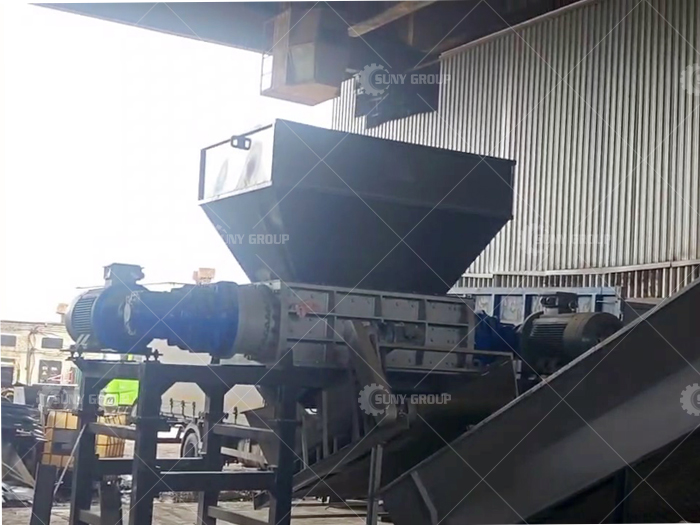
With the increasing amount of industrial waste, efficiently and stably handling various types of solid waste has become the focus of many companies. The double-shaft industrial shredder developed by SUNY GROUP plays a key role in waste volume reduction, resource recovery, garbage pretreatment, and other fields with its strong power and excellent shredding ability.
The equipment uses two high-strength alloy blade shafts, combined with a low-speed, high-torque drive system, to process waste into regular or irregular small pieces by shearing, tearing, and extruding, which is convenient for subsequent transportation or reprocessing. Compared with the single-shaft structure, the double-shaft shredder has stronger adaptability and higher crushing efficiency, and is suitable for a variety of industrial waste such as plastic barrels, tires, metal parts, wooden pallets, cables, and electrical housings.
2-shaft Industrial Shredding Equipment
In terms of operation, the equipment adopts a PLC automatic control system, which can realize intelligent functions such as automatic start and stop, reverse protection, and anti-stuck, reducing the difficulty of manual operation and improving the continuity and safety of equipment operation. At the same time, the supporting transmission system is stable and reliable, simple to maintain, and greatly reduces the failure rate and downtime.
In terms of design details, the whole machine has a compact structure, the blades are detachable and replaceable, and some models are also equipped with a screen system, which can adjust the discharge size according to customer needs. In order to meet different production capacity requirements, manufacturers usually provide a variety of power and blade shaft length options, which are flexible and suitable for a variety of application scenarios, from small workshops to large factories.
With the advancement of environmental protection policies and the enhancement of resource recycling awareness, double-shaft industrial shredders are gradually becoming one of the core equipment in the solid waste treatment industry. If you are looking for an efficient, durable, and easy-to-maintain industrial shredding solution, double-shaft shredding equipment is undoubtedly a choice worth considering. Welcome to contact us for more technical information and customization suggestions. We will provide you with professional support and thoughtful service.
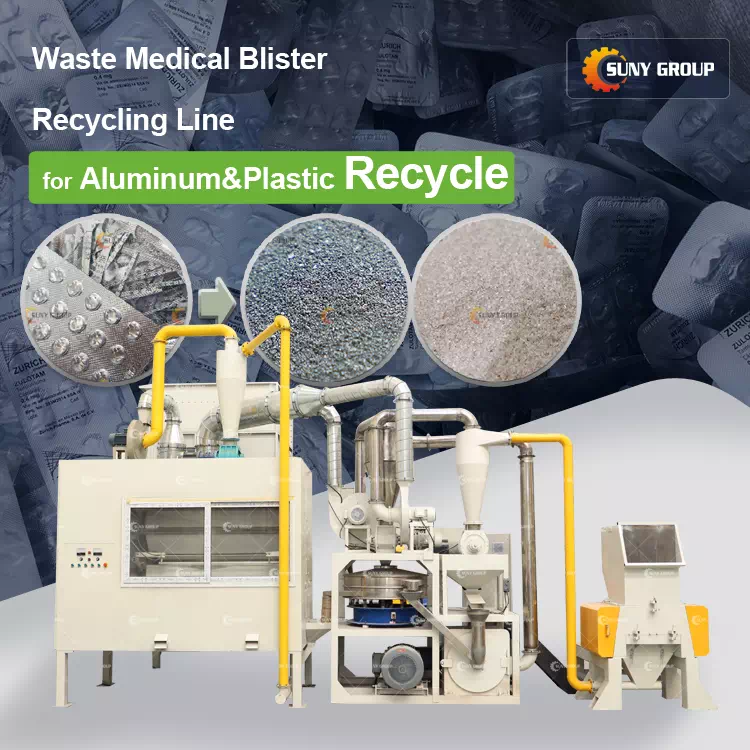
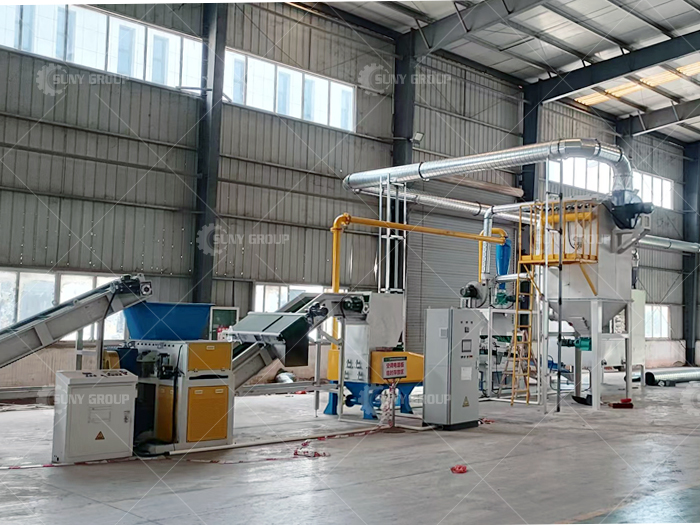
With the continuous development of the medical industry, pharmaceutical aluminum-plastic blister packaging (such as common tablet plates and capsule plates) is widely used, and the waste generated is also increasing. The Medical Blister Aluminum Plastic Crushing and Recycling Machine launched by SUNY GROUP provides an efficient and environmentally friendly solution for medical aluminum-plastic separation.
The equipment uses physical methods for crushing and sorting, without heating or the use of chemical agents, and is safe and environmentally friendly. First, the aluminum-plastic blister plate is crushed and ground to fully dissociate the aluminum foil and the plastic layer. Subsequently, the two materials are accurately separated by an electrostatic sorting system, and the purity of aluminum powder and plastic powder can reach more than 99%. The whole process is fully automated, stable, and easy to operate.
Medical Blister Aluminum Plastic Crushing and Recycling Machine
Compared with traditional treatment methods, this production line has the advantages of high separation efficiency, no pollution, and low energy consumption. It is not only suitable for aluminum-plastic packaging waste in the pharmaceutical industry, but also suitable for processing composite packaging of similar materials in food, daily chemicals, and other industries.
The sorted aluminum powder can be directly used for metal recycling, and the plastic powder can be used as recycled material for injection molding, granulation, and other processes to achieve resource recycling. The entire production line has a compact structure, small footprint, and reasonable investment cost, making it suitable for recycling companies and pharmaceutical factories.
SUNY GROUP is committed to the research and development of environmental protection equipment and the optimization of intelligent recycling solutions. Welcome to learn more about the equipment details and investment suggestions. If you are looking for an efficient aluminum-plastic separation solution, our professional team will provide you with one-to-one customized services.
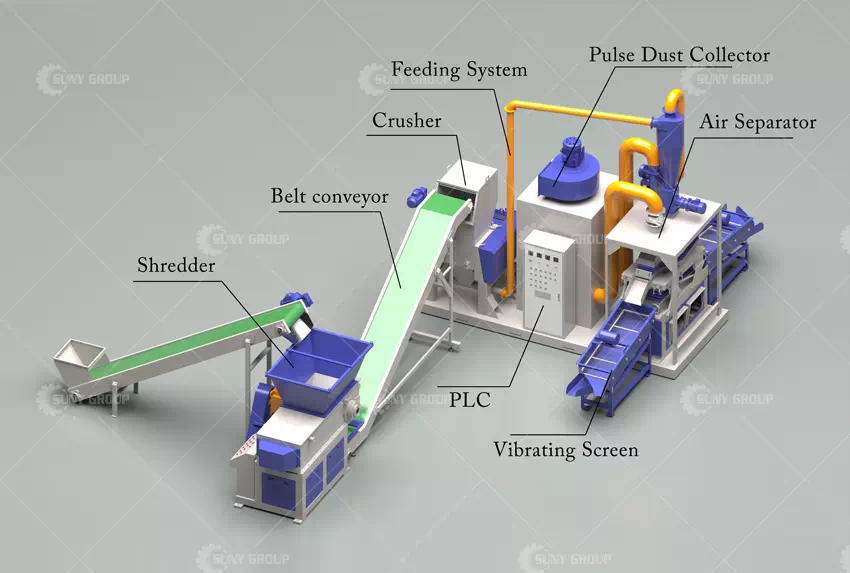
As e-waste continues to grow, cable recycling is becoming an important part of resource reuse. Modern cable pelletizing and separation technologies are revolutionizing the recycling of used wires with their efficient, automated processing, transforming what used to be waste into valuable metal raw materials.
Efficient granulation and separation technology
Cable recycling systems are able to achieve high recovery rates while maintaining metal purity by integrating shredding, pelletizing, and separation functions. An automatic feeding system introduces mixed cables into the cutting unit, where they are precisely pulverized and the metal conductors are effectively separated from the plastic insulation.
Efficient Solutions for Cable Recycling
Versatile capacity configurations
Depending on capacity requirements, the equipment is categorized into compact, mid-range industrial, and large-scale lines. Compact systems are suitable for small businesses and start-ups with a processing capacity of 30-150 kilograms per hour; mid-range systems support a higher processing capacity and level of automation and are suitable for day-to-day operations of recycling plants; and large-scale systems have a capacity of up to 1,800 kilograms per hour and are equipped with PLC control systems and a containerized design suitable for large-scale industrial recycling.
Core separation components and ancillary equipment
The entire process is scientifically efficient, from primary shredding and material transfer to multiple separation stages such as electrostatic and air classification. For large-size cables, a stripping system can also be equipped to further enhance the overall pelletizing efficiency. In addition, auxiliary equipment such as dust collection systems and magnetic sorting machines ensure environmental protection and safety.
Both environmental protection and economic benefits
Modern cable recycling equipment not only improves resource recovery rates but also reduces labor costs and automates operations. At the same time, the flexibility of the equipment allows companies to quickly respond to changes in metal prices and enhance market competitiveness. Please feel free to contact us for more details.