• SUNY Fackbook
  • SUNY Linkedin
  • SUNY Youtube
Categories
News

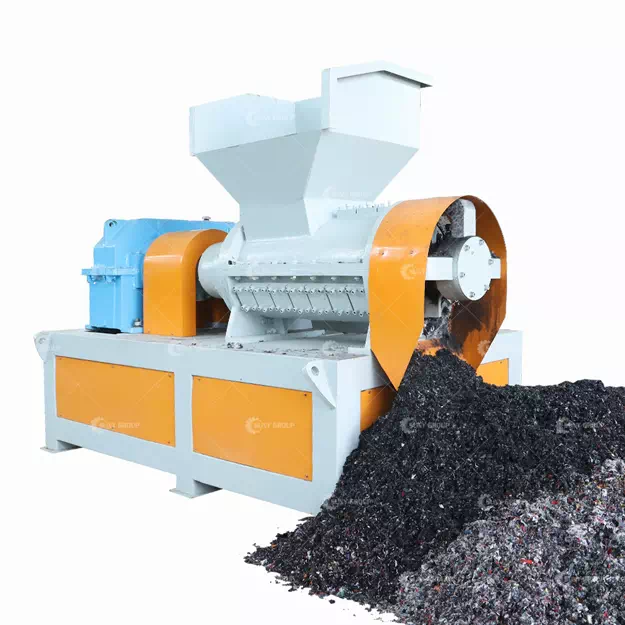
High Efficiency Spiral Shredder for Soft Material Recycling

For challenging materials like woven bags, old clothing, plastic film, fabrics, and soft packaging materials, SUNY GROUP introduces this 400–500kg/h screw shredder. Compact in size yet delivering exceptional output density, its simple structure maintains stable performance under continuous load—providing a truly actionable solution for small and medium-sized recycling enterprises.

Traditional shredders often encounter issues like entanglement, jamming, and frequent reversals when processing lightweight, thin, or soft materials. These problems not only reduce output but also increase motor strain.

This spiral shredder employs a unique spiral feed mechanism. It uses continuous advancement to naturally guide materials toward the blades, achieving truly smooth feeding. Whether processing fluffy woven bags, highly elastic fabrics, or easily tangled films, it maintains consistent gripping and advancement without “clogging up, tearing halfway, then stopping.”
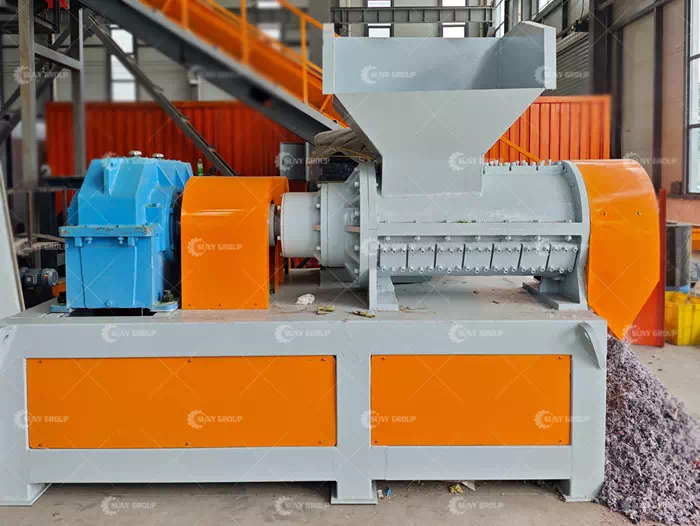
High Efficiency Spiral Shredder for Soft Material Recycling

High Efficiency Spiral Shredder for Soft Material Recycling

The machine’s de-tangling capability is significantly enhanced, requiring minimal manual intervention during continuous operation. This elevates production lines from mechanization to true automation.

In blade design, the spiral shredder employs high-toughness alloy blades for powerful cutting through soft materials. Force distribution across the entire chamber is more uniform, ensuring a smooth shredding process without sudden overloads or intermittent stoppages.

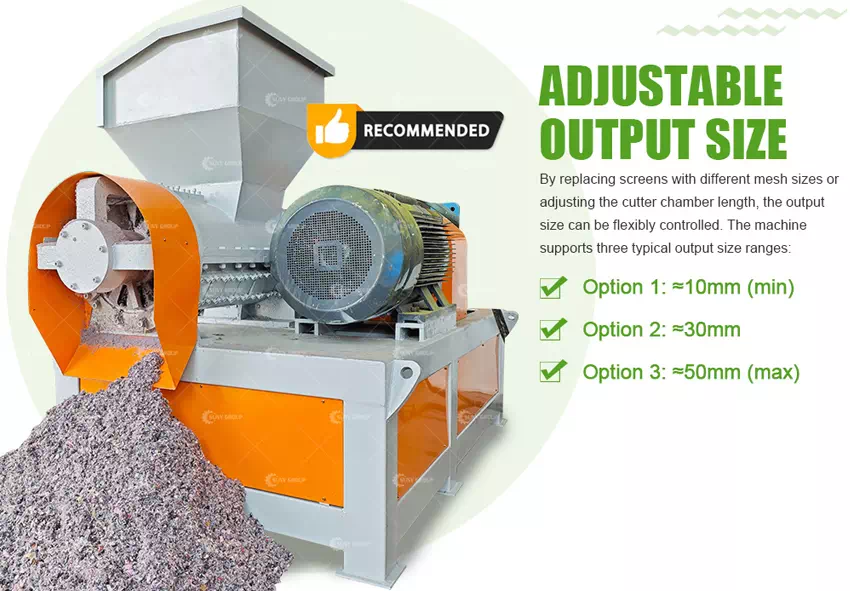
Output particle size can be flexibly adjusted to meet diverse industry and process requirements, covering 10mm, 30mm, and 50mm.

Fine particles are suitable for subsequent pelletizing and melt recycling; medium-sized particles are ideal for filling and reprocessing; larger sizes are best for secondary crushing.

This customizable cutting size enhances the equipment’s versatility, allowing businesses to adjust production strategies based on operational needs without being constrained by machinery limitations.

With a capacity of 400–500 kg/h, it serves as the primary machine for recycling woven bags, processing packaging waste, and textile recovery. Its compact design simplifies installation and layout, accommodating even limited factory floor space.

It can operate as a standalone unit or integrate with conveyors, washing lines, and sorting equipment to form a comprehensive recycling system. For businesses requiring higher throughput, we offer custom models with increased capacity, allowing systems to scale naturally with operational growth rather than being constrained by fixed equipment performance.

If you’re seeking a shredder that delivers efficient, stable performance, handles soft materials with ease, and maintains continuous output, this 400–500kg/h screw shredder is an excellent choice. Whether you have specific capacity requirements or are exploring larger-scale production line solutions, we provide detailed configurations and customization services tailored to your needs.
Categories
News

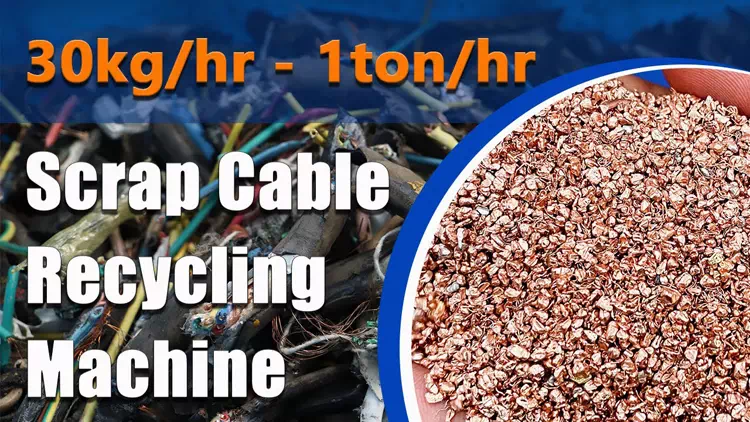
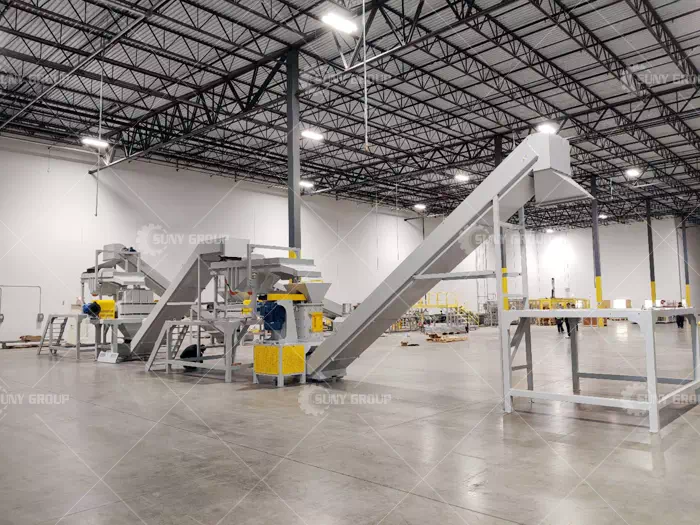
Copper Recovery Industrial Cable Recycling Equipment

In industrial waste treatment, scrap cables consistently account for a high proportion. With copper prices continuing to rise, how to efficiently and with low loss extract copper from cables has become a core variable for the profitability of recycling companies. Traditional manual wire stripping is not only inefficient but also prone to copper wire breakage and impurity contamination, affecting subsequent sales value. Therefore, more stable and automated cable recycling equipment is becoming the industry standard.

The Working Logic of Industrial-Grade Cable Recycling Equipment

This type of equipment achieves complete separation of copper and plastic through three coordinated steps: crushing, separation, and collection. A high-speed crushing system processes coarse cables into fine particles; a gravity separation system uses air classification and vibration principles to separate light plastic and heavy copper particles; finally, the copper particles are concentrated and output, achieving a high-cleanliness, low-impurity finished product. The entire process is closed-loop, requiring no complex manual intervention, reducing losses and avoiding dust pollution.

The core advantages of the equipment are reflected in several aspects. First, it has stable processing capacity, maintaining continuous operation whether for high-frequency operations involving appliance dismantling lines or long-term processing of large-diameter cables. Secondly, it yields high-purity copper, suitable for resmelting, refining, or reuse as a conductive material in production. Thirdly, it boasts strong versatility, handling everything from thin, weak wires to mixed cables and scrap communication lines without the need for frequent tool or module changes.

Key Equipment for Helping Businesses Reduce Costs and Increase Profits

For recycling companies, introducing industrial-grade copper recycling equipment is not only about improving efficiency but also about establishing a sustainable profit model. The equipment reduces the time cost of manual wire stripping and minimizes copper powder loss caused by traditional crushing methods. Higher copper recovery rates mean more marketable metal can be produced per ton of scrap cable; and stable automated operation allows for controllable production rhythms and easier output increases.

Furthermore, the enclosed dust collection structure of this type of equipment creates a cleaner working environment and lower workshop noise, aligning with environmental trends; the modular design simplifies daily maintenance and reduces downtime. For factories looking to expand their recycling scale or improve profitability per ton, it is a very practical and feasible solution.

If you want to build a cable copper recycling line with higher output, more stable efficiency, and better recycling rate, I can recommend a suitable model based on your cable type, output target, and budget to help you reduce costs and increase copper recycling profits.

Categories
Case

Belgian Lithium Battery Recycling and Processing Equipment Customer Site

Belgian Lithium Battery Recycling and Processing Equipment Customer Site

Belgian Lithium Battery Recycling and Processing Equipment Customer Site

Categories
News

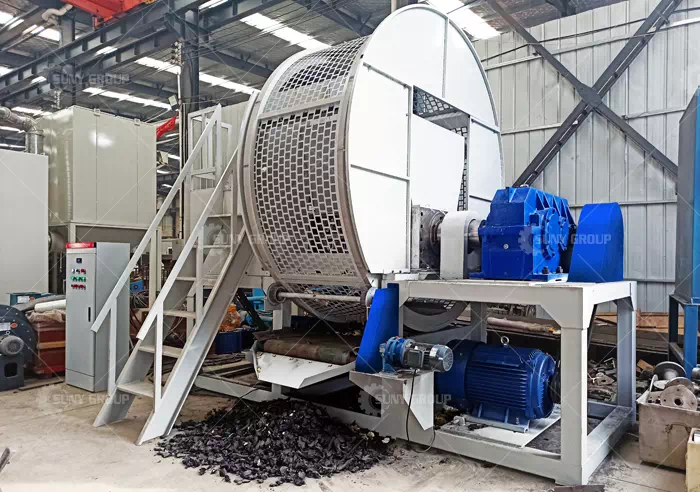
Scrap Tyre Wires Shredder Machine

Waste tires have a complex structure and high strength, making direct processing difficult. Dual-shaft shredders are specifically designed for this type of high-strength waste. The equipment uses a high-torque cutter shaft to quickly shred the tires into uniform rubber blocks, ensuring processing efficiency while avoiding excessive stretching and equipment wear.

During the shredding process, a rotating screen simultaneously controls the size of the rubber blocks. Only particles meeting the standard are discharged, ensuring smoother subsequent separation steps. The core objective of this step is to transform the entire tire into stable rubber blocks suitable for the next processing stage.

Scrap Tyre Wires Shredder Machine

Scrap Tyre Wires Shredder Machine

Tires contain a large number of high-strength steel wires, which must be separated to obtain high-purity rubber. After the rubber blocks enter the steel wire separator (also known as a heavy-duty shredder), they are further crushed and physically separated to efficiently separate the rubber from the steel wires.

The separated rubber particles are clean and uniform in size, and can be directly used in industries such as recycled rubber granules, track materials, floor mats, and vibration-damping bricks. The separated steel wires can also enter the metal recycling system, further improving overall recycling efficiency.

Its advantages include:

• High processing capacity, easily handling both whole and cut tires

• Precise shredding and separation, resulting in high-purity rubber granules

• Stable operation and low maintenance costs

• Rapidly improves raw material utilization efficiency and economic benefits

If you need information on equipment pricing, capacity specifications, or complete tire recycling solutions, please feel free to contact us. We will provide you with more professional technical support and detailed information.

Categories
News

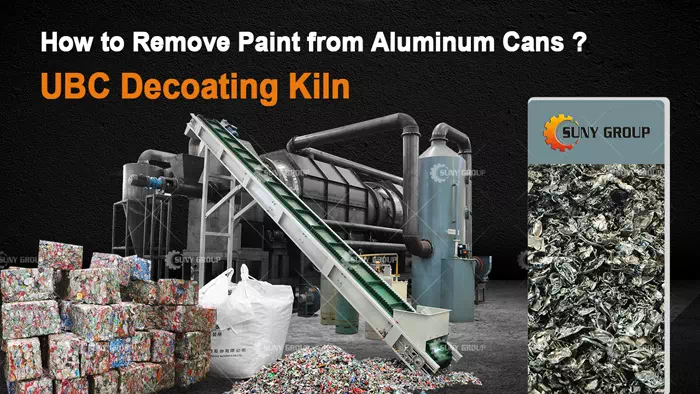
Shredded UBC Drying and Decoating Furnace

In the aluminum can (UBC) recycling industry, the paint removal process is the core step in achieving high-quality recycled aluminum. A complete paint removal process not only reduces aluminum loss during the smelting stage but also significantly improves production safety and yields cleaner, more marketable recycled aluminum. To process crushed UBC material, a drying paint removal furnace is an indispensable piece of specialized equipment.

Shredded UBC Drying and Decoating Furnace

Shredded UBC Drying and Decoating Furnace

In practical applications, the ink, coatings, and organic matter on the surface of UBC can affect the purity of subsequent smelting and can even cause safety hazards such as increased flue gas volume and internal furnace deflagration. Therefore, how to efficiently remove the coating is a problem that recycling companies must solve. For crushed aluminum can material, the most mature and reliable method currently is to use a paint removal furnace employing pyrolysis, also known as a rotary kiln paint removal system. This equipment utilizes the principle of high-temperature pyrolysis to decompose the organic coating on the aluminum surface into volatile gases in a closed environment, thereby completely removing the surface paint layer.

During the pyrolysis process, the material slowly rolls and is heated evenly, causing the paint layer to peel off quickly without damaging the aluminum substrate. The generated waste gas enters the waste gas treatment system at the rear of the furnace, where pollutants are thoroughly removed through incineration, filtration, and cooling, ensuring emissions meet standards and maintaining a clean production environment. The resulting aluminum is clean and uncoated, with lower smelting losses and significantly improved recycled aluminum quality.

For recycling plants looking to improve recycling efficiency and aluminum quality, the UBC drying and paint stripping furnace is a key investment that directly enhances the value of the production line. Please feel free to contact us if you would like to learn about specific equipment costs, parameters, and process configurations.

Categories
Case

South African Customer’s Circuit Board Recycling Equipment Site

South African Customer's Circuit Board Recycling Equipment Site

South African Customer’s Circuit Board Recycling Equipment Site

Categories
News

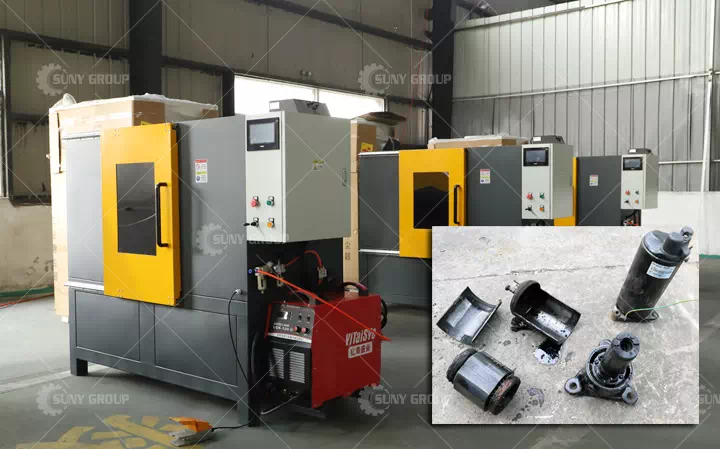
Compressor Shell Opening Machine Plasma Cutter

Compressors contain abundant metal and electronic components, making them a highly valuable part of electrical equipment recycling. To achieve efficient recycling and environmentally friendly reuse, SUNY GROUP has developed the Compressor Shell Opening Machine (Plasma Cutter), an intelligent device specifically designed for compressor dismantling, significantly improving recycling efficiency and safety.

Intelligent Plasma Cutting: Efficiently Dismantling Compressor Shells

This equipment utilizes advanced plasma cutting technology to quickly and precisely cut compressor shells of various sizes and shapes. Compared to traditional mechanical cutting methods, plasma technology offers advantages such as faster cutting speeds, a smaller heat-affected zone, and smoother cuts, making it easier to open the shells of air conditioner compressors, refrigerator compressors, and other similar components. Operators can freely set cutting parameters and directions according to the compressor’s shape, achieving personalized automatic cutting. The entire process is safe, stable, and efficient, avoiding the risks of sparks and secondary pollution.

Compressor Shell Opening Machine Plasma Cutter

Compressor Shell Opening Machine Plasma Cutter

Adjustable Cutting Modes: Meeting Diverse Needs

The equipment supports multiple cutting modes, allowing for flexible adjustment of cutting frequency and path based on different compressor types. For example, refrigerator compressors can be opened in one circular cut, while air conditioner compressors can be completely separated using a combination of upper and lower double-circle cutting and vertical cutting, making it easier to remove the internal stator and rotor. Controlled by a PLC touch system, the entire process is automated, significantly reducing manual intervention and improving operational safety and production efficiency.

Safe, Reliable, Environmentally Friendly, and Highly Efficient Recycling Equipment

The machine features a rational structural design, including a main frame, electrical control system, plasma power supply, lifting device, clamping mechanism, rotating device, and fume treatment system. Equipped with a complete smoke and dust removal system, the fumes generated during cutting are treated immediately to ensure environmental compliance. The equipment not only improves the automation and precision of compressor dismantling but also effectively helps companies achieve green recycling and resource reuse.

The plasma compressor casing cutter is an indispensable high-tech equipment in the compressor recycling industry chain, providing waste electrical and electronic equipment recycling companies with a safer, more efficient, and more environmentally friendly solution.

For equipment details or technical parameters, please feel free to contact us.

Categories
Products Shredder Equipment

Spiral Shredder for Soft Materials

BACKGROUND AND PAIN POINTS ADDRESSED

Traditional shredders processing soft or fibrous materials commonly suffer from high noise levels, blade entanglement, inconsistent discharge, and frequent maintenance. This is particularly evident in sectors like plastic packaging, waste textiles, and agricultural films, where balancing production efficiency and equipment longevity proves challenging. The spiral shredder for soft materials was developed specifically to address these industry challenges. Its low-speed operation and specialized blade design reduce dust and noise while effectively preventing entanglement and ensuring stable discharge. This significantly enhances continuous processing capability and environmental friendliness.

STRUCTURAL PRINCIPLES

Structural Principles

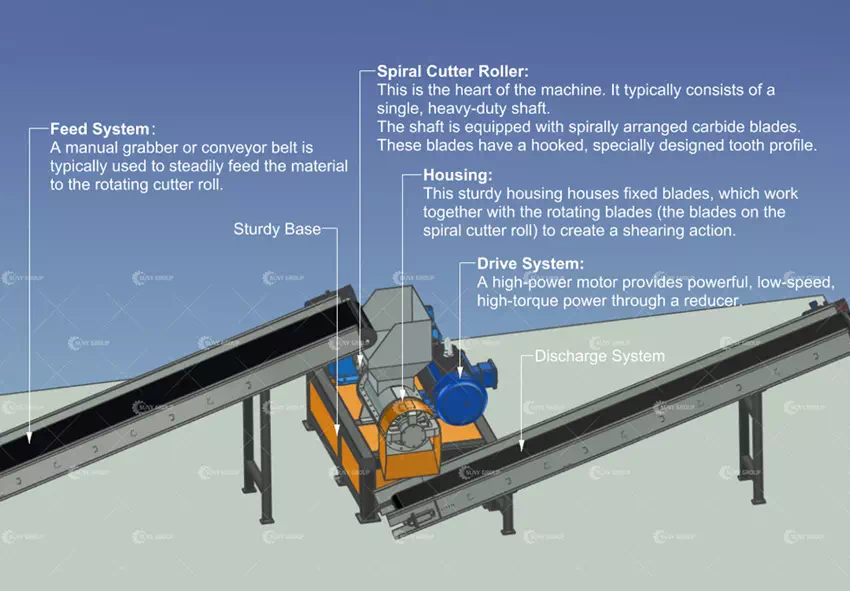
The core consists of a low-speed, high-torque screw rotor combined with hook-shaped alloy blades. Feed material is progressively drawn, torn, sheared, and compressed by the spiral blades to achieve multidimensional shredding. A heavy-duty motor and reduction system deliver continuous, stable power, while the thick steel frame ensures long-term operation under high loads. Discharge size (10mm–50mm) is flexibly controlled by replacing screens or adjusting chamber length to meet diverse process requirements.

APPLICABLE MATERIALS

APPLICABLE MATERIALS

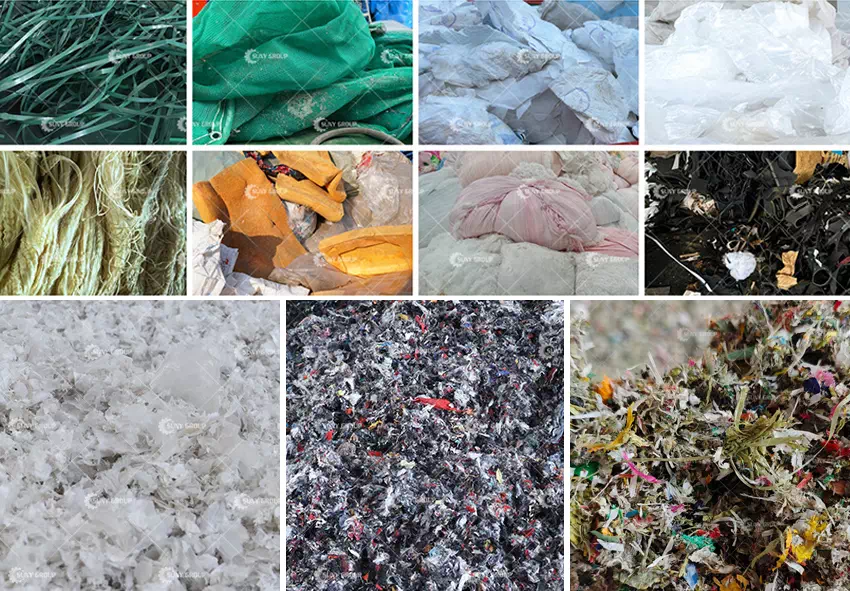
This machine processes diverse soft solid wastes: discarded garments, woven bags, plastic films, agricultural mulch, PP strapping bands, pet pads, and other rollable packaging materials. It delivers uniform, controllable discharge, serving as a pre-treatment stage for subsequent washing, pelletizing, compaction, or incineration—achieving volume reduction and efficient conveying.

MACHINE ADVANTAGES

MACHINE ADVANTAGES

Low Noise & Dust: Low-speed cutting significantly reduces dust and noise, making it suitable for workshops with stringent environmental requirements.

Robust Torque: A high-power motor paired with a heavy-duty gear reducer ensures continuous high-load operation.

Anti-Tangling Design: Spiral blades deliver a strong gripping force, effectively processing prone-to-tangle materials like fabrics and ropes.

Adjustable Output: Screen replacement enables variable particle sizes, flexibly adapting to downstream processes.

Easy Maintenance & Long Service Life: Modular structure facilitates cleaning and replacement, reducing operational costs.

This spiral shredder balances stability, durability, and adaptability, providing an efficient and reliable solution for soft material recycling and reuse.

Categories
News

Three-Stage Glass Crushing and Sorting Recycling Machine

This three-stage glass crushing and sorting recycling equipment is designed for the efficient recycling of various types of waste glass, including beverage bottles, glass jars, and architectural glass, enabling rapid crushing and precise grading. With increasing environmental awareness and the widespread use of recycled resources, this compact yet powerful machine is becoming an essential production tool for glass recycling companies and processing plants.

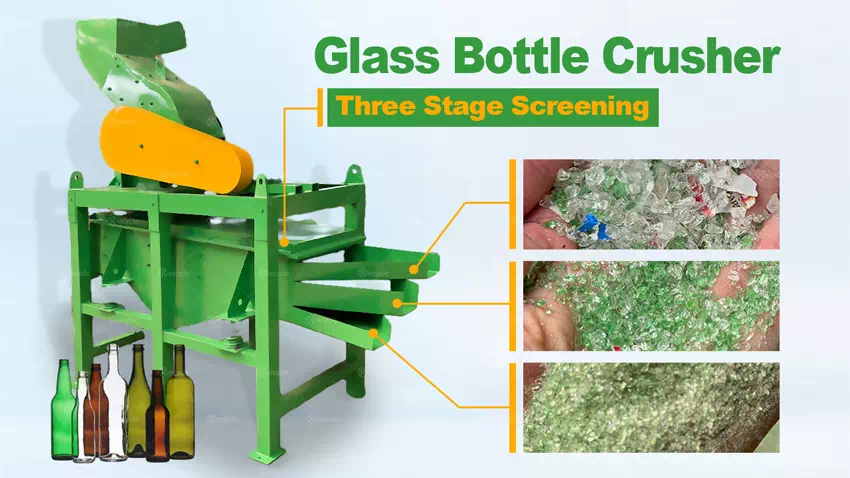
The equipment employs an advanced three-stage crushing and screening system, capable of efficiently processing and finely grading glass. The first stage uses a high-strength crusher to pulverize whole bottles of glass into small pieces; the second stage further refines the fragments, making the particles more uniform; the third stage utilizes a built-in screening system to separate the crushed glass into three different particle sizes—coarse, medium, and fine—suitable for direct application in glass remanufacturing, building materials, or decorative filling.

Three-Stage Glass Crushing and Sorting Recycling Machine

Three-Stage Glass Crushing and Sorting Recycling Machine

Despite its compact size, this equipment boasts powerful performance. Its robust structural design and intelligent control system ensure stable operation over extended periods. The fully enclosed structure effectively prevents dust leakage, maintaining a clean and safe working environment. Major components are constructed from high-strength, wear-resistant materials, suitable for long-term high-load operation and offering a longer service life.

Easy operation and maintenance are major highlights of this equipment. It’s suitable for both small and medium-sized recycling stations and large-scale recycling centers. The modular design allows for quick parts replacement and low maintenance costs. Users can also flexibly adjust the crushing intensity and screening parameters according to actual production needs to achieve ideal crushing and sorting results while reducing energy consumption.

This glass recycling system not only improves recycling efficiency but also helps businesses practice sustainable development. Precise particle size classification allows recycled glass to be directly used in multi-industry production without additional processing, significantly improving economic efficiency. At the same time, the equipment operates quietly, efficiently, and with low energy consumption, meeting modern environmental standards.

If you are looking for a stable, efficient, and environmentally friendly small-scale glass recycling system, this three-stage glass crushing and sorting recycling system is an ideal choice. Please contact us for detailed configuration, processing capacity, and pricing information, as well as comprehensive technical support and solutions.