



Heavy-Duty Copper Cable Recycling & Granulating Line
A heavy-duty copper cable recycling and pelletising line is an industrial recycling system designed to process waste copper cables and mixed wires. Through crushing, sorting, and the separation of metal from plastic, it enables the recovery and reuse of copper resources. Typically designed with a production capacity of 500 kg/h or more, it is widely used in metal recycling plants and resource recovery facilities.
Definition and Capacity Standards for Heavy-Duty Pelletising Lines
Within the industry, copper cable recycling equipment is generally categorised according to its processing capacity. When processing capacity exceeds 500 kg/h, the equipment is generally classified as a heavy-duty copper cable pelletising system. This type of equipment is designed to meet large-scale recycling demands rather than small-scale, workshop-style processing. The equipment featured in this case study has a designed capacity of 1,000 kg/h and is designed for high-load continuous operation. It is capable of handling the centralised processing of large volumes of mixed waste materials, such as scrap cables, telecommunications cables and automotive wiring harnesses, and demonstrates greater adaptability to fluctuations in feedstock composition.
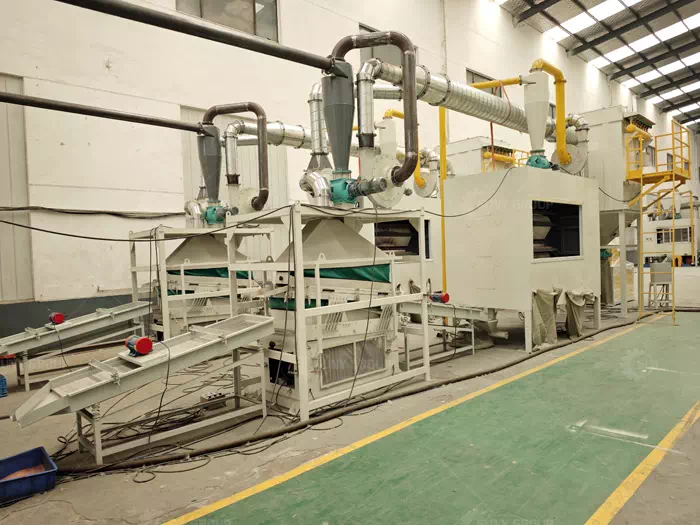
Heavy-Duty Copper Cable Recycling & Granulating Line
Composition of the Core Shredding System and Processing Flow
The core of the entire production line consists of a multi-stage shredding system, comprising a twin-shaft shredder, a single-shaft shredder and a final shredder. The twin-shaft shredder is primarily responsible for the coarse shredding and initial volume reduction of bulky cables, ensuring the material enters the next stage uniformly; the single-shaft shredder further reduces the material size, enabling thorough separation of the copper core from the outer insulation; the final shredding system is used for fine processing, enhancing the efficiency of subsequent sorting. The advantage of this multi-stage crushing structure lies in reducing the load on individual machines whilst improving overall stability and continuous production capacity.
Dual Sorting System and Advantages in Recovery Efficiency
The equipment is configured with two sorting systems, which achieve efficient separation of copper and plastic through a combination of air classification and density separation. The first stage of sorting primarily removes lightweight plastics and impurities, whilst the second stage further enhances the purity of the copper particles, resulting in more stable purity and particle uniformity in the final recovered copper. Compared to a single-stage sorting configuration, this dual-system design effectively reduces copper loss rates and improves overall recovery rates, whilst minimising the costs associated with secondary manual sorting. It is therefore well-suited to industrial applications where high levels of cost-effectiveness and stability are required.
From an overall structural perspective, this type of 1,000 kg/h copper cable recycling and pelletising line is essentially a combined ‘high-load crushing + multi-stage sorting’ system, with the focus not on the performance of individual machines, but on the synergistic efficiency of the entire line and the continuity of material processing.
When selecting equipment, overseas customers typically focus on three core indicators: production capacity stability, copper recovery purity and operational energy consumption; these are also the key criteria for determining whether the entire production line possesses industrial-scale value.
If you have any requirement or suggestion, please fill in the form and send to us, thanks!E-mail:[email protected] | Whatsapp:+8613674945231
INQUIRY