



Safe Li Ion Battery Recycling Line Pyrolysis Secondary Combustion Separation
The core of lithium-ion battery recycling lies in the combination of thermal treatment and physical sorting equipment to ensure the safe processing of undischarged batteries and the efficient recovery of metal resources. Such recycling lines can enhance material reuse rates whilst mitigating safety risks, and are suitable for the large-scale processing of power batteries and various types of waste lithium-ion batteries.
Pyrolysis and Secondary Combustion System: Addressing Safety and Environmental Concerns
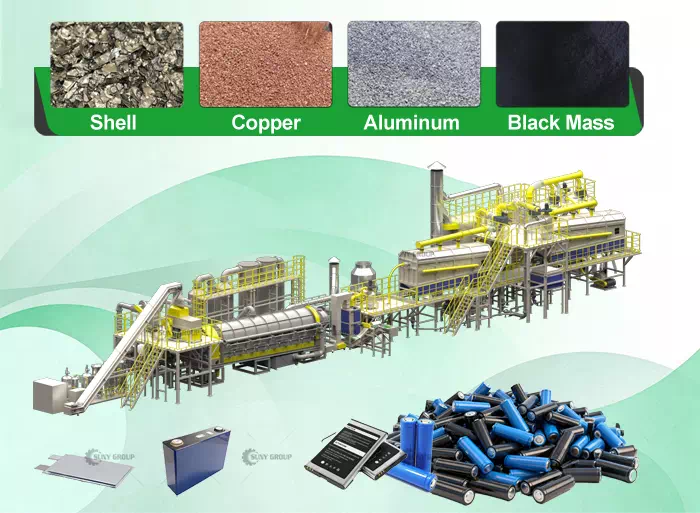
The entire recycling line relies first on a pyrolysis furnace to carry out the critical ‘pre-treatment’ stage. Undischarged lithium-ion batteries are fed directly into a sealed pyrolysis unit, where they are decomposed in an oxygen-free or low-oxygen environment, effectively eliminating the risk of combustion or explosion caused by residual charge. Through this process, volatile components such as electrolyte and organic solvents are separated.
Safe Li Ion Battery Recycling Line Pyrolysis Secondary Combustion Separation
Subsequently, the system’s secondary combustion unit subjects the combustible gases generated during pyrolysis to high-temperature treatment, further decomposing harmful substances and reducing organic pollutants in the exhaust gases. This combination not only enhances the safety of the entire line but also ensures emissions comply with environmental regulations, forming a fundamental component for the stable operation of the entire system.
Crushing and Sorting System: Achieving Efficient Material Recovery
After thermal treatment, the batteries enter the mechanical processing stage. First, multi-stage crushing is carried out by crushing equipment to thoroughly disassemble the battery structure, creating conditions for subsequent sorting. At this stage, metals and non-metals have been largely separated.
Next, different materials are sorted using air classification, magnetic separation, and screening equipment. For example, metals such as copper and aluminium are separated by physical means, whilst black powder (containing valuable metals such as lithium, cobalt, and nickel) is collected centrally to serve as a key raw material for subsequent smelting or further processing. This stage determines the resource recovery efficiency of the entire production line.
Integrated Line Design: Enhancing Stability and Adaptability
The key to this lithium-ion battery recycling production line lies not in individual equipment, but in its systematic design. The various modules are interconnected via conveying and sealing systems, enabling continuous operation and minimising manual intervention. Furthermore, the equipment parameters can be adjusted to accommodate batteries of different specifications (such as cylindrical, prismatic, and pouch types), demonstrating a degree of adaptability.
In addition, the entire line is typically equipped with dust extraction and exhaust gas treatment systems to ensure a safe and clean production environment, preventing dust and harmful gases from affecting operators.
Against the backdrop of the ever-increasing volume of end-of-life lithium-ion batteries, integrated equipment solutions combining pyrolysis, safe disposal, and efficient sorting are gradually becoming the industry standard. For enterprises, selecting a recycling production line with a rational structure and stable operation is not only crucial for safe production but also directly impacts the economic value of resource recovery.
If you have any requirement or suggestion, please fill in the form and send to us, thanks!E-mail:[email protected] | Whatsapp:+8613674945231
INQUIRY