



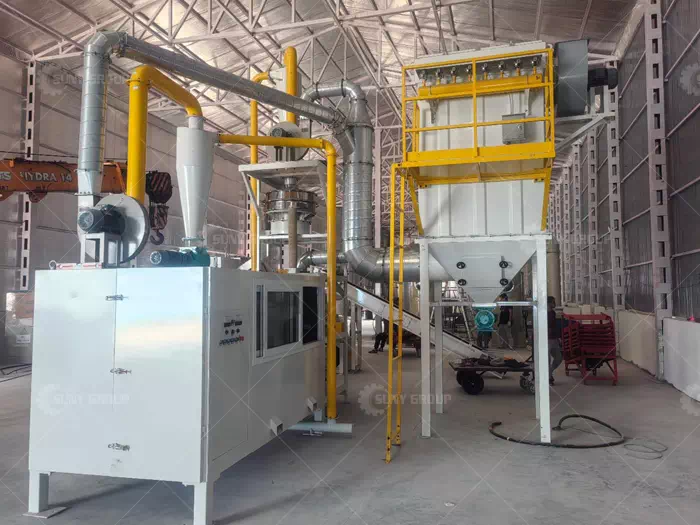
Nepal E-waste Recycling Machine Customer Site
Nepal E-waste Recycling Machine Customer Site
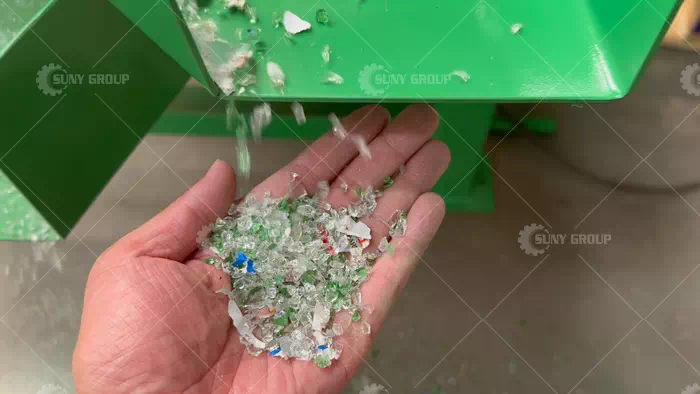
Addressing the issues of uneven particle size and low crushing efficiency in the recycling of glass bottles and glass products, SUNY Group offers a three-stage screening glass crusher. This compact machine integrates crushing, screening, and finished-product grading, processing waste glass into three distinct particle sizes and uniform shapes in a single operation. It is ideal for glass recycling plants, winery recycling systems, waste treatment plants, and environmental resource recycling companies.
The core highlight of the equipment is its “three-stage screening structure,” which separates glass particles of different sizes within the same machine, eliminating the need for secondary manual screening, significantly improving efficiency, and ensuring consistent finished product quality.
Glass Recycling 3 Stage Machine
Three-stage structure design: Fully automated from crushing to grading
This glass crusher features a high-efficiency crushing chamber design that quickly crushes waste materials such as glass bottles and glasses, creating uniformly mixed particles in the first stage.
The crushed material enters the internal three-stage screening system, where precisely controlled screen apertures and vibration trajectories achieve automated particle separation:
• Coarse particle zone: Suitable as a base material for recycled glass, usable in building material filling or glass remelting processes. • Medium-particle zone: Commonly used in decorative materials, garden paving, and reprocessing of art glass.
• Fine-particle zone: Can be used as a base material for high-value-added products such as glass sand and abrasives.
The entire process requires no additional air classification or water washing. The equipment can operate continuously and stably, is easy to maintain, has low overall energy consumption, and is suitable for long-term high-load operation.
If you would like to learn more about the technical details, processing capacity, configuration options, or equipment quotation for the three-stage screening glass crusher, please feel free to contact us. We will provide professional advice and deliver complete solutions tailored to your material and output requirements.

Small Household Appliance Recycling Production Line Customer Site
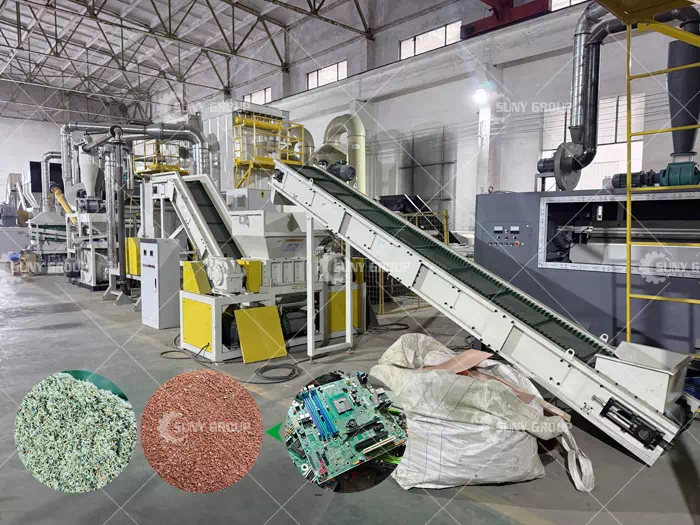
Electronic waste, particularly discarded computer circuit boards (PCBs), contains high-value components such as copper, tin, gold, silver, and resin. A complete PCB recycling technology solution can achieve efficient recycling through mechanical and physical sorting methods.
The high-efficiency crushing system is the starting point for recycling. Computer motherboards, graphics cards, circuit boards, etc., are automatically fed into the crusher via a conveyor system. The multi-stage hammer crushing structure gradually pulverizes the PCBs to a uniform particle size, creating a more ideal particle shape for subsequent sorting. Compared to single-stage crushing, multi-stage crushing significantly reduces dust generation, and the metal particles are more regularly shaped, which is beneficial for revealing differences in metal conductivity. If higher fineness is required, a fine-grinding system can be added to grind the material to 60-120 mesh, improving the separation of metals and non-metals. The entire crushing process operates in a closed loop and can be combined with a pulse dust collector to ensure stable and compliant dust emissions.
Waste Computer Printed Circuit Board Recycling Solution
The crushed mixture then enters the electrostatic separation system, which is the core technology of the entire solution. PCB metals are highly conductive, while resin and glass fiber are non-conductive. Utilizing this difference, electrostatic separators can precisely separate metal powders into individual finished products, enabling the recovery of copper, tin, and other metal resources without chemical solvents. For higher purity, secondary electrostatic separation or gravity separation can be used for further purification, ensuring a stable copper recovery rate of over 98%. The recovered resin powder can be used in board materials, building materials, or fillers, forming a reusable closed loop. For larger production lines, high-frequency eddy current separators can be added to recover residual conductive particles, improving overall resource utilization.
For recycling plants with higher production demands, automated feeding and stable output can be achieved, equipped with water-cooling or air-cooling systems to maintain stable power output even during long-term operation. The entire PCB recycling line can be customized, including crushing capacity, sorting accuracy, dust removal systems, and finished product output methods, suitable for various scenarios such as electronic waste recycling companies, environmental resource regeneration plants, and metal sorting and processing lines. Whether processing old computer mainframes, TV boards, communication equipment boards, or upgrading large-scale recycling plant production lines, it can be quickly deployed and achieve stable profitability. If you are looking for a computer PCB recycling solution with higher recycling rates, greater environmental friendliness, and better cost-effectiveness, please get in touch with us for detailed production capacity parameters, equipment specifications, and investment configuration suggestions. A mature recycling system will help you turn electronic waste into substantial profits.